

Acid Reflux Is Dissolving Your Teeth: Here’s What the Damage Looks Like
Quick answer
Acid reflux tooth erosion is enamel loss caused by stomach acid reaching the mouth, and it looks nothing like a cavity. It appears on the inside (palatal) surfaces of the upper front teeth and the chewing surfaces of the lower molars — a pattern dietary acid does not produce. The teeth look glassy and yellower, the front edges go translucent, and old fillings start to stand above the tooth around them. It is common: a 2022 meta-analysis found dental erosion in about half of patients with reflux. Many of those people have no heartburn at all, so the erosion is sometimes the first sign anyone sees. Enamel does not grow back, so the goal is to find the acid and stop it before more is lost.
What acid reflux tooth erosion actually is — and why it isn’t a cavity
I want to start by separating two things that get confused constantly, because the confusion is the reason people wait too long.
A cavity is a bacterial problem. Bacteria sit in a specific spot — a groove, a contact point between two teeth, the margin of an old filling — and the acid they produce as they feed drills a hole in one place. It is local. It has edges. On an X-ray it looks like a dark notch with a shape.
Acid reflux tooth erosion is a chemical problem, and it has no edges. Stomach acid is strong enough to dissolve the mineral out of enamel directly, with no bacteria involved at all. It does not drill. It washes. So instead of a hole in one place, you get a whole surface that is thinner than it used to be — smooth, glassy, rounded, and slightly yellower, because the enamel over the top has gone translucent and the dentin underneath is showing through.
That difference matters clinically. A cavity announces itself: it gets caught on an X-ray, it gets a filling, the story ends. Erosion does not announce itself. It takes years, it is painless for most of those years, and because nothing looks broken, most people assume nothing is happening. By the time a patient sits down in my chair and says their teeth look short, or their front teeth have gone see-through at the tips, I am usually looking at something that has been going on for five to ten years.
Enamel is the hardest substance your body makes, and it is also the only major tissue in your body with no cells in it. There is nothing alive in there to rebuild it. Bone heals. Skin heals. Enamel does not. Whatever is gone is gone permanently, which is why I get fairly direct with patients about this: the goal is never to reverse erosion, because that is not available. The goal is to find the acid and turn it off before the next millimetre goes.
The pattern tells me the source: stomach acid versus the lemon water
Here is the part I find most useful, and the part almost nobody knows walking in.
Acid damages whatever surface it pools against. So the location of the wear tells you where the acid came from, and it is remarkably reliable.
Dietary acid — citrus, soda, sports drinks, kombucha, wine, sparkling water with lemon, vinegar-heavy dressings, chewable vitamin C — comes in through the front of the mouth and washes across the outer surfaces. The wear shows up on the front of the teeth, the side you see when you smile, often with a band of damage near the gumline.
Stomach acid arrives from behind and below. It pools against the inside of the upper front teeth and sits on the chewing surfaces of the lower molars. The 2023 British Dental Journal review of gastrointestinal conditions and tooth wear describes exactly this signature: “wear on the palatal aspects of maxillary teeth and the occlusal surfaces of mandibular molars,” and notes it is especially suggestive of reflux “in the absence of significant dietary acids.”
That is the single most diagnostic thing in this entire article. When I tilt a mirror behind someone’s upper front teeth and the inside surfaces are scooped out and shiny while the outside surfaces look essentially normal, I am not looking at a diet problem. Lemon water does not reach the back of your upper incisors. Stomach contents do.
There is a third pattern worth naming, because it comes up more than people expect: the same BDJ review notes that erosion can appear high on the cheek-side of the upper teeth “if the patient holds gastric contents in their cheeks.” That one tends to point toward recurrent vomiting rather than passive reflux, and it changes the conversation I need to have — carefully, and privately.
“But I don’t get heartburn” — why silent reflux is the hard case
This is the sentence I hear most often, and it is the reason erosion gets missed for years.
Heartburn is a symptom of reflux. It is not a requirement of reflux. Plenty of people move acid up into the oesophagus and mouth without ever feeling the burn, usually because the reflux happens while they are lying down and asleep and the episodes are short. The British Dental Journal review is blunt about it: a proportion of patients “will, however, have silent reflux,” and in one group, patients with extensive erosion on the inside of their upper teeth had pathological reflux but “did not have any systemic symptoms of reflux” at all.
Then it says the thing I want every patient in Pompano Beach to understand: “in silent reflux, dental erosion may be the only clinical sign present.”
Read that again. For some people, the first and only evidence that acid is coming up is the shape of their teeth. Not a burning chest. Not a sour taste. The teeth.
This is why I ask about reflux even when a patient has told me they feel fine, and it is why I do not accept “no heartburn” as a reason to stop looking. If the wear pattern says stomach acid, the wear pattern wins. The ADA’s own position is that gastric acid reaching the mouth is an erosive challenge regardless of whether the patient has been given a diagnosis — and my job, when the pattern is there, is to say so and send you to someone who can investigate the cause.
The scale is not small either. A 2022 meta-analysis in Dentistry Journal pooled the available studies and found dental erosion in 51.5% of patients with gastro-oesophageal reflux disease (95% CI: 39.7–63.2), with the odds of erosion five times higher than in people without reflux (OR 5.00, 95% CI: 3.00–8.35). Roughly half. If you have been diagnosed with reflux and nobody has looked at your teeth specifically for this, that is a gap worth closing.
The early signs you can see in your own mirror
You do not need equipment for the first pass. Stand at a window in daylight, not under a bathroom light, and look for these.
Your front teeth have gone translucent at the tips. The last two or three millimetres look grey, glassy, or almost clear, like frosted glass held up to the light. That is enamel thinning from behind until light passes straight through the edge.
The edges look chipped or notched. Eroded enamel is thin, and thin enamel fractures. People usually blame a specific incident — a fork, a bottle cap, an almond. The incident was the last straw, not the cause.
Your teeth look yellower than they did, and whitening isn’t fixing it. This one frustrates people. The yellow is not stain on the surface; it is the colour of the dentin underneath showing through enamel that has thinned. Whitening works on stain. It does not work on anatomy, and on eroded teeth it often just produces sensitivity.
Your old fillings are standing up above the tooth. Composite and porcelain do not dissolve in acid. Enamel does. So if a filling you have had for years now feels like a raised island with the tooth sloping away from it, the filling did not grow. The tooth around it got lower. In my view this is the most underrated sign on the list, because it is objective — nobody’s memory of their own teeth is reliable, but a filling that now sits proud of the surface is a measurement.
Your teeth look shorter, or your smile shows less tooth than it used to. Compare an old photograph. Patients are often right about this and are often told they are imagining it.
The signs you can only feel
Some of this does not show up in a mirror.
Sensitivity to cold that is spreading rather than spiking. A cracked tooth or a deep cavity gives you a sharp, localised, memorable pain in one tooth. Erosion gives you a broad, dull ache across several teeth, often worse on the lower molars, often triggered by cold air as much as cold drinks. When a patient tells me “the whole left side is sensitive,” erosion moves up my list.
Edges that feel sharp against your tongue. Thinned enamel chips into fine sharp edges. Your tongue will find them before your eyes do.
Your bite feels different, or you feel like you are biting into nothing. When the chewing surfaces of the lower molars erode, the back teeth stop meeting the way they used to and the front teeth take more of the load. People describe this as teeth that “don’t line up any more.” That is a real change, and it is worth taking seriously, because once the front teeth are carrying a load they were not designed for, the chipping accelerates.
A sour or metallic taste in the morning, or a hoarse voice before your first coffee. Not a dental sign exactly, but it travels with the dental signs, and it is often the detail that finally makes the reflux explanation land.
And one that is easy to dismiss: persistent bad breath that brushing does not touch. Halitosis has a long list of causes and most of them are in the mouth, but reflux is on that list, and I have written separately about what chronic bad breath can tell you about the rest of your health.
What I look at when I suspect reflux
An erosion exam is different from a cavity check, and I want to describe it, because patients who know what I am doing tend to engage with it much better.
I look from behind. Most of the diagnostic information is on the palatal surfaces of the upper teeth, which means a mirror and good light, not an X-ray. Erosion is largely invisible on standard X-rays until it is severe, because it thins surfaces rather than making holes. If you have been told your X-rays look fine, that is not a clearance for erosion.
I photograph it. This is the part that actually changes outcomes. Erosion is slow, and the only way to know whether it is still active or whether it stopped years ago is to compare the same surfaces over time. Photographs and, where useful, digital scans give me a baseline. Twelve months later I can tell you whether we are winning. Without a baseline I am guessing, and so are you.
I grade it rather than eyeballing it. Dentistry has a standard index for this — the Basic Erosive Wear Examination — which scores each sextant by how much surface is affected. The reason to use a score instead of an impression is the same reason to photograph: it makes “a bit worse” into a number, and a number can be tracked.
I ask about the last three years of your life, not your diet alone. Pregnancy, a period of heavy drinking, a change in reflux medication, a new sleep position, weight change, a stressful stretch with late dinners, chronic cough, asthma inhalers, endurance sports and the sports drinks that go with them, eating disorders past or present. I ask all of it, and I ask it without judgement, because the history is often the whole answer.
And I check what else is loading the teeth. Erosion plus grinding is a much faster problem than either alone: acid softens the surface, and clenching then abrades the softened layer away. Softened enamel is measurably more vulnerable for a window after an acid exposure, which is why I take a grinding history seriously in anyone with erosion, and why night guards come up in this conversation. I have written about how bruxism quietly wrecks teeth and about what actually helps jaw pain and clenching, and both of those are directly relevant if your erosion is moving quickly.
A composite patient scenario
The following is a composite scenario. It is assembled from several patients’ presentations to illustrate a typical pattern, and it does not describe any individual patient.
A woman in her mid-fifties comes in because her front teeth have “gone see-through” and her whitening toothpaste has stopped working. She has no dental pain. She has not had a cavity in eleven years and she is, by any measure, a careful patient: electric brush, flosses, keeps her cleanings.
Her outer tooth surfaces look good. When I put a mirror behind her upper front teeth, the inside surfaces are scooped and glossy, and the edges of the upper incisors are thin enough to be translucent for about two millimetres. Two old composite fillings on her lower molars are standing distinctly above the surrounding tooth. The chewing surfaces of those molars are cupped — small shallow craters where the enamel has dissolved away around harder spots.
I ask about heartburn. She says she does not get it. I ask what time she eats dinner. Around nine, because of her work. I ask whether she wakes with a sour taste. She stops, and says yes — most mornings, and she assumed that was normal. I ask about her voice in the mornings. Hoarse until her second coffee, for years.
So: no heartburn, and a textbook stomach-acid wear pattern. I photograph everything, score the erosion, and write to her physician describing what I am seeing and why I think reflux is worth investigating. She is eventually diagnosed and treated on the medical side. On the dental side we do three unglamorous things — move her last meal earlier, change what she does after a reflux episode, and start high-fluoride toothpaste — and we add a night guard, because she is also a clencher.
At twelve months the photographs look the same as the baseline. Nothing has been restored, nothing has been reversed, and that is the win. We stopped it. Later, when she wants to, we will rebuild the worn edges of her front teeth, and we will be rebuilding onto a mouth where the acid is no longer running.
Why this is a whole-health conversation, not a dental one
I treat the mouth as part of the body rather than a sealed compartment, and erosion is one of the cleanest examples of why.
The acid damaging those teeth is not a mouth problem that happened to involve the stomach. It is a stomach problem that happens to show up in the mouth first, because enamel is the thing in its path that cannot repair itself. The oesophagus is being exposed to the same acid, and the oesophagus is the organ where that exposure has consequences that matter a great deal more than the shape of your incisors. When I find this pattern and write to your physician, I am not being thorough about your teeth. I am flagging something upstream.
The American Dental Association’s patient resource, MouthHealthy, puts the mechanism plainly: with reflux, “gastric acids reach the mouth throughout the day,” and this is “especially damaging when you’re asleep.” Their recommendation set is a whole-body one, not a dental one — avoid alcohol and smoking, do not eat within three hours of bedtime, and “work with your physician” on treating the underlying stomach problem, while seeing your dentist regularly so the erosion and any dry mouth can be monitored.
That is the right framing. The dentist monitors and protects. The physician treats the cause. Neither half works alone, and I have watched plenty of patients get reflux medication without anybody ever looking at their teeth, and plenty more get their teeth restored without anybody addressing the acid — which is how a beautiful restoration ends up sitting in a mouth that will erode around it.
If this sounds like a theme, it is: the same logic runs through gum disease and cardiovascular risk and through the broader link between oral health and overall well-being. The mouth is a window, and in erosion it is a window that opens earlier than most.
The three hours before bed matter more than anything else
If you change one thing after reading this, change when you stop eating.
Reflux at night is worse than reflux during the day for two reasons that compound each other. You are horizontal, so gravity stops helping. And you barely produce saliva while you are asleep, which removes your main defence — saliva neutralises acid and carries calcium and phosphate that help re-harden softened enamel. So night-time acid arrives against teeth that have no buffer and stays there for hours.
The ADA’s own guidance is to not eat within three hours of bedtime. In practice, that is the single highest-yield change available to most of my patients, and it is free. For people who eat late because of shift work or a long commute, the fix is usually to move the largest meal earlier and keep anything after it small and non-acidic, rather than to skip dinner.
Two other things help at night: raising the head of the bed rather than stacking pillows, and sleeping on your left side. Both are standard reflux advice rather than dental advice, which is exactly the point — the dental benefit is downstream of controlling the reflux.
Brushing right after is the instinct that does the most damage
This is the mistake I most want to undo, because it is well-intentioned and it does real damage.
After an acid exposure, the surface layer of your enamel is temporarily softened. Brushing a softened surface scrubs away mineral that would otherwise have re-hardened on its own over the following hour or two. You are not cleaning the acid off. You are sanding the tooth.
The ADA says it directly. For acidic drinks: “Rinse with water rather than brushing teeth immediately after consuming acidic beverages.” And for patients who vomit, the ADA’s guidance is that they “should be cautioned against brushing their teeth immediately after vomiting,” advising rinsing with water, a sodium bicarbonate rinse, or milk instead.
So the sequence after a reflux episode or after vomiting is: rinse, wait, then brush.
- Rinse immediately with plain water. A teaspoon of baking soda in a glass of water is better still, because it neutralises rather than just dilutes. Milk also works.
- Wait before brushing. Thirty minutes is the usual advice; longer does no harm.
- Then brush, with a soft brush and fluoride toothpaste, which is also the ADA’s routine recommendation for these patients.
One more that catches people out: the ADA notes that reflux medicines can cause dry mouth, and that less saliva raises cavity risk. So a patient on long-term reflux treatment can trade an erosion problem for a dry-mouth problem if nobody is watching, which is another argument for being seen regularly rather than only when something hurts.
What I do to protect the teeth while your reflux is treated
Treating the reflux is not my job. Protecting the teeth while that happens is, and there is more available than most patients expect.
High-fluoride toothpaste. Prescription-strength fluoride toothpaste is the workhorse here. The ADA notes fluoride and desensitising toothpastes “may help strengthen tooth enamel,” and in eroded mouths this is where I start, because it both hardens the remaining surface and takes the edge off the sensitivity.
In-office fluoride varnish at shorter intervals. For active erosion I shorten the recall interval and apply varnish at each visit rather than annually.
A night guard, if you clench. Not for the erosion itself, but because clenching on acid-softened enamel removes it far faster than either factor would alone. This is the most common combination I see in erosion patients who are losing ground quickly.
Sugar-free gum after meals. Simple and evidence-backed. MouthHealthy’s recommendation is that “chewing sugar-free gum can encourage saliva production, which helps neutralize and wash away the acids in your mouth,” and they specify gum carrying the ADA Seal.
Shorter recalls with photographs each time. Erosion is a slope, not an event. Regular professional cleanings are the natural checkpoint for re-photographing the same surfaces and comparing, and that comparison is what tells us whether the plan is working or whether something needs to change.
And a straw, used properly. For the acidic drinks you are not going to give up, a straw placed behind the front teeth genuinely reduces contact. Also: stop swishing acidic drinks, and do not hold them in your mouth.
When the enamel is already gone: rebuilding without over-treating
Eventually some patients need restoration, and I want to be careful about how I describe this, because erosion is a condition where it is easy to do too much too early.
My sequencing is almost always the same. Stabilise first. I do not rebuild a mouth where the acid is still running, because restorations placed into an active erosive environment fail at their margins and the tooth continues to dissolve around them. So: cause addressed, protective measures in place, photographs showing it has stopped. Then we restore.
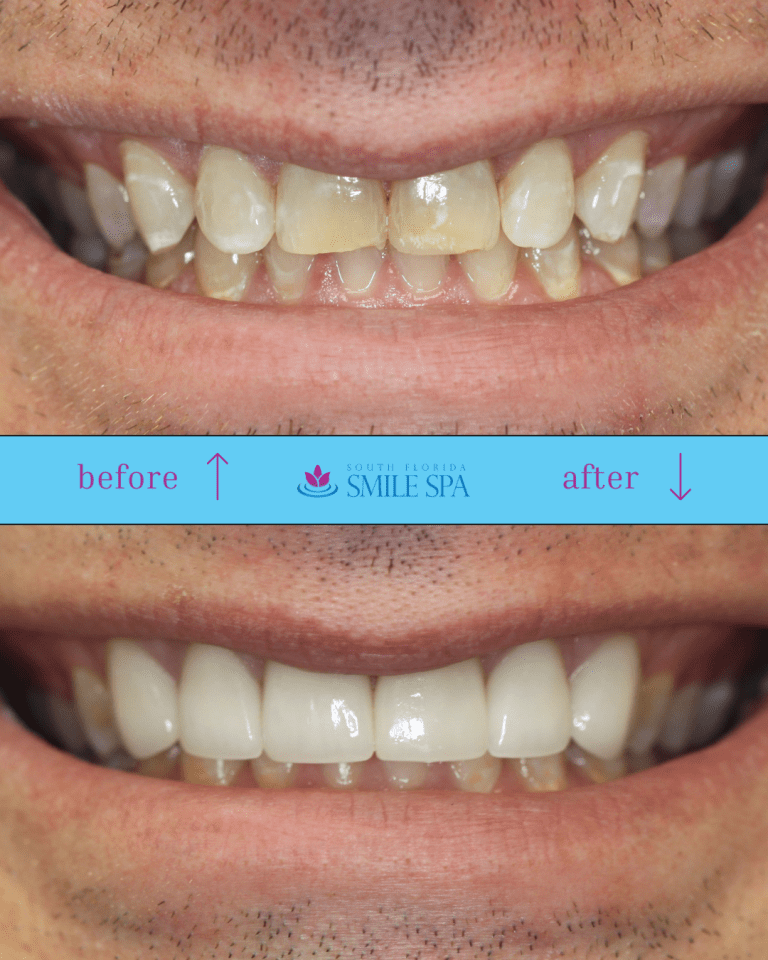
Then do the least that solves the problem. For worn, translucent, chipped front edges, composite bonding added directly to the worn edge is often all that is needed, and it has a real advantage: it is additive. I am adding material to a tooth that has already lost material, rather than removing more of what is left. For a patient in their fifties with ten years of restorative decisions ahead, that matters.
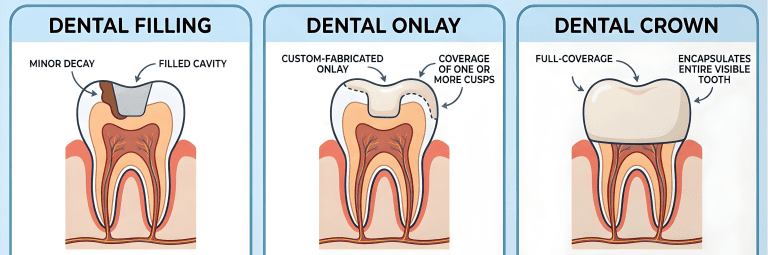
Porcelain when bonding isn’t enough. Where the wear is extensive, where the appearance matters a great deal to the patient, or where composite has not held, veneers or crowns become the better answer. How much tooth is left is what decides between them, which is a judgement I have written about at length in crown, filling, or onlay: how much tooth is left decides the answer.
Occasionally, a full rebuild. When erosion has gone on for decades and the back teeth have lost enough height that the bite itself has collapsed, restoring one tooth at a time stops working, and the case needs to be planned as a whole. That is full-mouth rehabilitation, and it is a different kind of undertaking — planned, staged, and not something to drift into by accident. One reason I am so insistent about catching erosion early is that early erosion is a tube of toothpaste and a dinner-time change, and late erosion is this.
For patients who find long appointments difficult, or who have been avoiding care for years and now need a substantial amount of it, combining treatment under sedation is often what makes it possible at all — and if you have a medical condition in the mix, how I handle medical clearance for dental sedation covers how that gets planned safely.
Questions patients ask me about acid reflux and tooth erosion
Can a dentist tell if I have acid reflux?
I can tell you that your teeth show a pattern of wear consistent with stomach acid, and that pattern is specific enough to be worth acting on — erosion on the inside surfaces of the upper teeth and the chewing surfaces of the lower molars is not something diet produces. What I cannot do is diagnose reflux, which is a medical diagnosis made by a physician, usually with history and sometimes with testing. What I do is describe exactly what I am seeing, in writing, and refer you with your permission so it can be properly investigated. In a meaningful number of patients, the teeth are the first evidence anyone has that acid is coming up.
Which teeth does acid reflux damage first?
The inside surfaces of the upper front teeth and the chewing surfaces of the lower back teeth. Stomach acid pools in those places when you are lying down, and those two areas are the classic signature. Dietary acid does the opposite — it damages the outer, front-facing surfaces. That is why the location of the wear is more informative than the amount of it, and why I always look behind the upper front teeth with a mirror rather than relying on what is visible when you smile.
Can tooth enamel grow back after acid reflux erosion?
No. Enamel has no living cells in it, so it cannot regenerate the way bone or skin does — once it is lost, it is gone permanently. What can happen is remineralisation of the outer softened layer: saliva and fluoride can re-harden enamel that has been softened but not yet lost, which is why fluoride toothpaste and saliva stimulation matter so much. But that re-hardens what is still there; it does not rebuild thickness. Anything already dissolved away has to be replaced with a restorative material if it needs replacing at all.
Should I brush my teeth after acid reflux or vomiting?
Not immediately. Acid temporarily softens the surface of the enamel, and brushing at that moment removes mineral that would otherwise have re-hardened on its own. The ADA specifically cautions against brushing immediately after vomiting and advises rinsing instead. Rinse right away with plain water, or better, water with a little baking soda, or milk. Wait about thirty minutes. Then brush with a soft brush and fluoride toothpaste. This single change in sequence protects more enamel over the years than most things people do deliberately for their teeth.
Does reflux medication protect my teeth?
Indirectly, and incompletely. Controlling the reflux reduces how often acid reaches your mouth, which is the most important thing — but medication does not rebuild enamel you have already lost, and it does not guarantee no acid is reaching your teeth, particularly if you still have breakthrough episodes at night. There is also a catch worth knowing about: reflux medicines can cause dry mouth, and less saliva means less natural buffering and a higher cavity risk. So being on treatment is good news for your teeth, but it is not a reason to stop monitoring them.
Is acid reflux tooth erosion the same as a cavity?
No, and they need different responses. A cavity is bacterial decay in one spot that gets repaired. Erosion is chemical dissolving across whole surfaces, and the repair is secondary to switching off the acid. You can have excellent oral hygiene, no bacteria problem at all, and significant erosion — which is precisely why so many careful patients are surprised. Erosion also tends to be missed on standard X-rays until it is advanced, because it thins surfaces instead of making holes, so normal X-rays are not a clearance.
How soon should I see a dentist if I have acid reflux?
If you have a reflux diagnosis and nobody has examined your teeth specifically for erosion, make that appointment now rather than waiting for your next routine cleaning — about half of people with reflux have some degree of erosion, and the point of looking early is to establish a baseline while there is still plenty of enamel to protect. If you have no diagnosis but you are seeing the signs described here — translucent front edges, fillings standing above the tooth, cupped molars, a morning sour taste — the same applies. There is no symptom that reliably tells you erosion has started, so looking is the only way to know.
What to do next
If any of this sounds like your teeth, the useful next step is small: an exam where somebody looks specifically for this pattern, photographs it, and gives you a baseline. That is a short appointment, and it is the difference between catching erosion while it is a toothpaste-and-dinner-time problem and catching it when it has become a rebuilding problem.
South Florida Smile Spa is at 572 E McNab Rd, Suite 102, Pompano Beach, FL 33060, and you can reach the office at (954) 785-1100. Our hours are Monday 8:30 AM–12:30 PM, Tuesday 8:00 AM–5:00 PM, Wednesday 8:30 AM–12:30 PM, Thursday 9:30 AM–6:30 PM, and Friday 8:00 AM–5:00 PM. We are closed Saturday and Sunday.
If you have a reflux diagnosis, bring it up when you book. It changes what I look at, and it changes where I put the mirror.
— Dr. Nicole M. Berger, DDS
Seeing the signs on your own teeth? An exam that looks specifically for this pattern gives you a baseline while there is still enamel to protect.
South Florida Smile Spa · 572 E McNab Rd, Suite 102, Pompano Beach, FL 33060 · (954) 785-1100

Dr. Nicole M. Berger, DDS
Dr. Berger has cared for patients in Pompano Beach for over two decades at South Florida Smile Spa, with a focus on cosmetic dentistry, implants and reconstruction, and sedation options for anxious patients.