


Crown, Filling, or Onlay: How Much Tooth Is Left Decides the Answer
Quick answer
Crown vs filling vs onlay — how does a dentist decide which one a tooth needs?
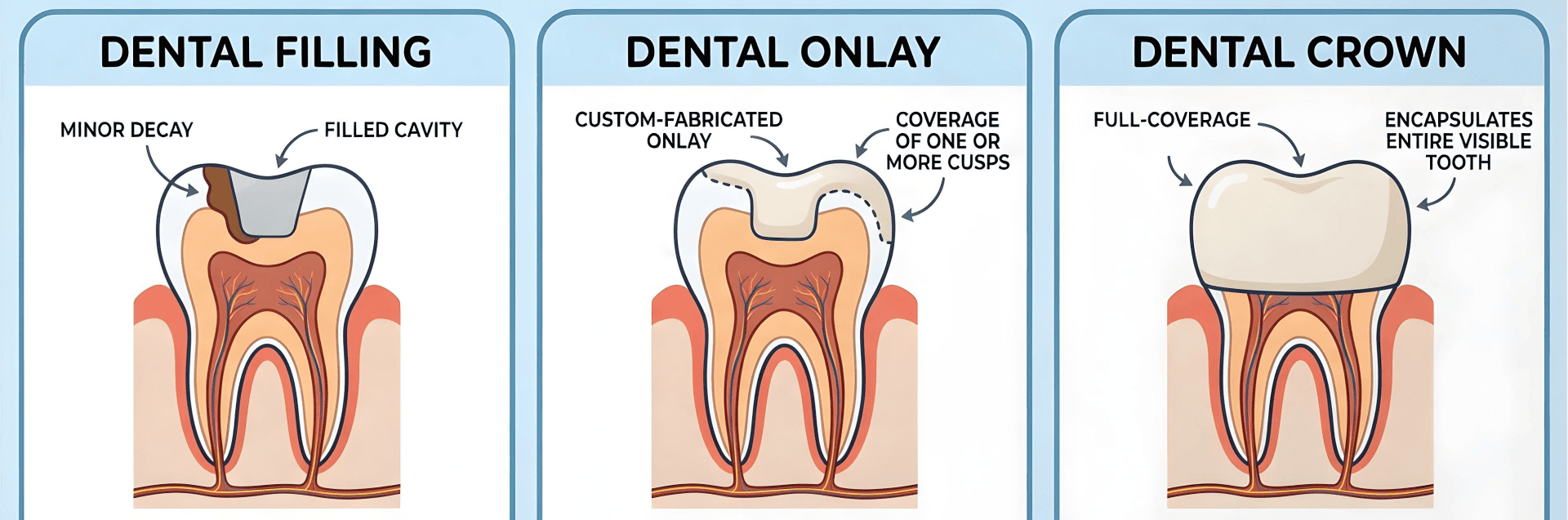
The choice comes down to one measurement: how much sound tooth structure is left after the decay, the crack or the old filling is removed. A filling works when the damage is small and the tooth’s outer walls are intact. An onlay rebuilds one or more damaged cusps while leaving the healthy rest of the tooth alone. A crown covers the whole tooth when there is no longer enough structure to support anything smaller. In Pompano Beach, Dr. Nicole M. Berger, DDS makes that call in the chair, often after the old filling is out, and can mill an onlay or crown the same day with CEREC.
By Dr. Nicole M. Berger, DDS — South Florida Smile Spa, Pompano Beach
“Do I need a crown, or can you just fill it?” is one of the most common questions I get, and patients are often surprised that the honest answer is: I will tell you once I can see what is left. Crown vs filling vs onlay is not a matter of what a dentist prefers or what a practice likes to sell. It is a structural decision about how much healthy tooth remains and how much force it has to carry for the next ten or twenty years.
This post is the one I wish every patient could read before they sit down. It explains what each restoration actually does, where the line between them sits, why I rarely default to a crown, and what happens to a tooth when the decision keeps getting postponed. Later posts in this series will go deeper on same-day versus lab-made crowns, crown materials, and why a root-canal tooth almost always needs a crown — this is the page they all come back to.
The one question that decides it: how much sound tooth is left
Picture a back tooth as a small box with four walls and a lid made of cusps — the raised points that do the chewing. Decay, cracks and old fillings all remove parts of that box. Every restoration I place has to be supported by what remains, and the remaining tooth has to be strong enough not to fracture around it.
So the question I am actually answering is not “how big is the hole?” It is “how much of the box is still standing, and can it carry a bite?” A cavity between two teeth on an otherwise solid molar leaves the walls and cusps intact — that tooth can be filled. A molar that lost a cusp when an old silver filling finally gave way has lost part of its lid; the remaining walls are thin, and a filling wedged into the middle would push them apart with every bite. That tooth needs something that covers and protects, not something that sits inside.
A common rule of thumb in restorative dentistry is that once a filling would need to be wider than roughly half the distance between the cusps, the tooth is a candidate for cuspal coverage — an onlay or a crown — rather than a bigger filling. It is a guide, not a law, but it explains most of the decisions I make.
Filling: when the walls are intact
A filling repairs a defect inside a tooth whose outer structure is still sound. I remove the decay, bond a tooth-colored composite into the space, shape it and polish it. It is conservative — it removes only what is damaged — and for small to moderate cavities it is the right answer.
Fillings stop being the right answer when they get large. A big composite in a molar is a wedge sitting in the middle of the tooth; the cusps around it are unsupported and take the chewing load on their thinned-out edges. That is how a tooth ends up in my chair with a cusp sheared off, usually while eating something perfectly ordinary. Patients say “but it didn’t hurt” — it rarely does until it breaks. If you have a large old filling and you feel a sharp zing on release when you bite, read my post on what to do about a cracked or broken tooth; that symptom is the tooth warning you.
Onlay: the middle option most people never hear about
An onlay is the restoration I reach for more often than patients expect, and it is the one almost nobody has heard of. It is a ceramic piece, milled to fit, that rebuilds one or more damaged cusps and covers the chewing surface — but it leaves the healthy walls of the tooth untouched. Think of it as replacing the damaged part of the lid instead of putting a new roof over the whole house.
That distinction matters because a crown requires the tooth to be trimmed down on every side so the cap can fit over it. An onlay does not. When a tooth has lost a cusp or has a large failing filling but still has two or three strong walls, an onlay restores it while preserving enamel that would otherwise be ground away for a crown. Enamel does not grow back. Keeping it is the whole point.
Onlays are bonded rather than cemented, which lets them reinforce the remaining structure instead of just sitting on it, and we mill them from ceramic in the office with our CEREC system, so most are placed in a single visit. A smaller cousin, the inlay, fits inside the cusps without covering them — I use it occasionally where a filling would be too large but no cusp is compromised.
Crown: when nothing smaller will hold
A crown covers the entire tooth above the gum line. It is the right choice when there is not enough sound structure left to support an onlay: a tooth that has fractured on more than one side, a tooth with an old filling so large that the walls are paper-thin, a tooth that has had root canal treatment and is now brittle and hollow, or a tooth that is cracked through a cusp and needs to be held together. In those cases full coverage is not overtreatment — it is the only thing that keeps the tooth from splitting.
What a crown takes from the tooth is structure. To fit a crown I have to reduce the tooth on all sides, which removes healthy enamel along with the damaged part. That is a fair trade when the alternative is losing the tooth. It is a poor trade when an onlay would have done the job. Which material the crown is made from — zirconia, lithium-disilicate ceramic, or porcelain fused to metal — is its own decision, and I will cover it in a separate post next month.
Crown vs filling vs onlay at a glance
- Filling — for small to moderate decay with intact outer walls. Removes only the damage. Placed in one visit. Typically lasts years, less when it is large or on a heavy-chewing molar.
- Onlay — for a tooth that has lost one or more cusps or has a large failing filling, with two or more strong walls remaining. Rebuilds and covers the damaged cusps; preserves the healthy walls. Milled in-office and bonded, usually same day. Typically outlasts a large filling by a wide margin.
- Crown — for a tooth with too little structure for anything smaller: multiple fractured walls, a root-canal-treated tooth, a deep crack. Covers the whole tooth; requires reduction on all sides. Same day with CEREC for most single crowns, or lab-made for complex cases. Typically the longest-lasting of the three when the foundation is sound.
Why I do not default to a crown
There is a pattern in dentistry sometimes called the restorative cycle. A filling is placed. Years later it is replaced with a bigger filling. That fails and becomes a crown. The crown eventually needs a root canal, then a new crown, and at some point there is not enough tooth left and the conversation turns to extraction and an implant. Each step removes more tooth, and the tooth never gets any back.
The way to slow that cycle down is to choose the most conservative restoration that will actually hold, and to stop treating a crown as the automatic upgrade. An onlay placed at the right moment can keep a tooth in the “still has its walls” category for a very long time. I would rather place an onlay today and a crown in fifteen years than a crown today and an implant in fifteen years.
How the decision is made in the chair
I can usually predict the answer from the exam and the X-ray, but I do not promise it, because the most important information is often hidden under the old filling. Here is what the workup looks like at South Florida Smile Spa:
- Exam and bite check. Where is the damage, is there a crack, and what does this tooth do when you chew? A tooth that hurts on release is treated differently from one that hurts on cold.
- Imaging. A standard X-ray shows decay between teeth and under fillings. If I suspect a crack that the X-ray cannot show, our cone beam scan can find fractures and infection at the root before we commit to a plan.
- Remove the old restoration and look. This is the moment of truth. Once the old filling and the decay are out, I can measure exactly how much tooth is standing and whether the walls are thick enough to support an onlay or need a crown.
- Choose the restoration that fits what is left — not the one that was planned. If I told you “probably a filling” and the tooth turns out to need an onlay, I will tell you why before I proceed.
- Make it and place it. With CEREC, an onlay or crown is scanned, designed and milled while you wait; you leave with the final restoration rather than a temporary.
If you clench or grind, one more factor enters the calculation: the restoration will be loaded far harder than normal chewing, and a large filling on a grinder’s molar is living on borrowed time. My post on bruxism and nighttime grinding explains the wear patterns I look for, and why a night guard protects the new work as much as the old teeth.
What happens if you wait
A tooth that needs an onlay and does not get one does not stay put. The unsupported cusp fractures, the tooth becomes a crown case, and if the fracture runs deep enough the nerve is exposed and it becomes a root canal case. If the crack reaches the root, no restoration can save it. I see this progression every week, and the difference between the first step and the last is usually a year or two of “I’ll deal with it later.”
It reaches beyond the tooth, too. People with a broken or sensitive molar chew on the other side and quietly drop the foods that require real chewing — raw vegetables, nuts, lean protein — which I write about in how missing and broken teeth change what you eat. A tooth that fractures on a weekend becomes a dental emergency instead of a scheduled visit. And a tooth that finally gets extracted starts the much longer conversation about how to replace it. The cheapest restoration a tooth ever gets, in structure rather than dollars, is the one placed early. The American Dental Association’s overview of crowns makes the same point: crowns protect weakened teeth, but the goal is always to preserve as much natural tooth as possible.
A representative case
| The following is a composite scenario drawn from patterns seen in practice, not the record of any single patient. A man in his fifties came in because a lower molar had “felt funny” for months and then chipped while he was eating an apple. The tooth had a silver filling from his twenties. On the X-ray the filling looked fine, but under magnification I could see a hairline crack running from its edge across one cusp, and the cusp that chipped was the one on that crack. When I removed the old filling, two of the four walls were thick and healthy, one was moderately worn, and the cracked cusp was gone. That is an onlay tooth: enough structure to preserve, not enough to fill. We milled a ceramic onlay that morning and bonded it in place. He kept the two healthy walls he would have lost to a crown, and the crack, sealed under bonded ceramic, has stayed quiet. |
Same day or lab-made, and where sedation fits
Most single onlays and crowns are milled in our office with CEREC while you wait — one visit, no temporary, no second appointment. Some cases still go to a lab: front teeth where color matching is the priority, complex bites, and multi-tooth work as part of a full-mouth rehabilitation. I will lay out how I make that call in the next post in this series. And if the reason a large filling has gone untreated is fear of the chair, you should know that we do restorative work under IV sedation — I administer and monitor it personally — and my guide for patients who are terrified of the dentist is an honest place to start.
If you have a large old filling, a tooth that zings when you bite, or a cusp that has already chipped, the decision about crown vs filling vs onlay is not one you need to make yourself. Bring the tooth in. I will show you what is left, and we will choose the restoration that keeps as much of your tooth as possible.
Find out what your tooth actually needs. Large old filling? A tooth that zings when you bite? Dr. Nicole M. Berger, DDS will show you how much tooth is left and choose the restoration that keeps the most of it — often finished the same day. South Florida Smile Spa · 572 E McNab Rd, Suite 102, Pompano Beach · (954) 785-1100
Frequently asked questions: crown vs filling vs onlay
Crown vs filling vs onlay — what is the actual difference?
A filling repairs a defect inside a tooth whose outer walls are intact. An onlay rebuilds and covers one or more damaged cusps while leaving the healthy walls untouched. A crown covers the whole tooth above the gum line and requires the tooth to be reduced on all sides. The choice depends on how much sound tooth structure is left, not on preference.
When do you need a crown instead of a filling?
When there is not enough healthy tooth to support a filling: multiple fractured or thin walls, a filling that would be wider than roughly half the distance between the cusps, a tooth that has had root canal treatment, or a crack running through a cusp. In those situations a filling would wedge the remaining walls apart; full coverage holds the tooth together.
Is an onlay better than a crown?
Neither is better in general; each fits a different amount of remaining tooth. When a tooth still has two or more strong walls, an onlay is usually preferable because it preserves enamel that a crown would remove. When the walls are too thin or too few, a crown is the safer choice. Dr. Berger chooses the most conservative restoration that will reliably hold.
Can a dentist tell whether I need a crown or an onlay before starting?
Usually a good prediction can be made from the exam and X-ray, but the final decision is often made after the old filling and decay are removed, when the remaining structure can be measured directly. If the plan changes at that point, the reason is explained before treatment continues.
How long do fillings, onlays and crowns last?
It depends on the size of the restoration, the tooth, your bite and whether you grind. As a general pattern, small fillings last for years, large fillings on molars fail sooner, and bonded ceramic onlays and well-supported crowns typically last considerably longer. Clenching or grinding shortens the life of all three, which is why a night guard is often recommended.
Can an onlay or crown be done in one visit?
Yes, in most cases. South Florida Smile Spa mills ceramic onlays and single crowns in the office with a CEREC system, so the tooth is scanned, the restoration designed and milled, and it is bonded in place during the same appointment. Some cases, such as front teeth with demanding color matching or multi-tooth work, are sent to a dental laboratory.
What happens if a large filling is left alone?
Large fillings leave the surrounding cusps unsupported. Over time a cusp typically fractures, turning what could have been an onlay into a crown. If the fracture reaches the nerve the tooth needs root canal treatment, and if it reaches the root the tooth usually cannot be saved. Treating early preserves the most tooth.

Dr. Nicole M. Berger, DDS
Dr. Berger has cared for patients in Pompano Beach for over two decades at South Florida Smile Spa, with a focus on cosmetic dentistry, implants and reconstruction, and sedation options for anxious patients.