


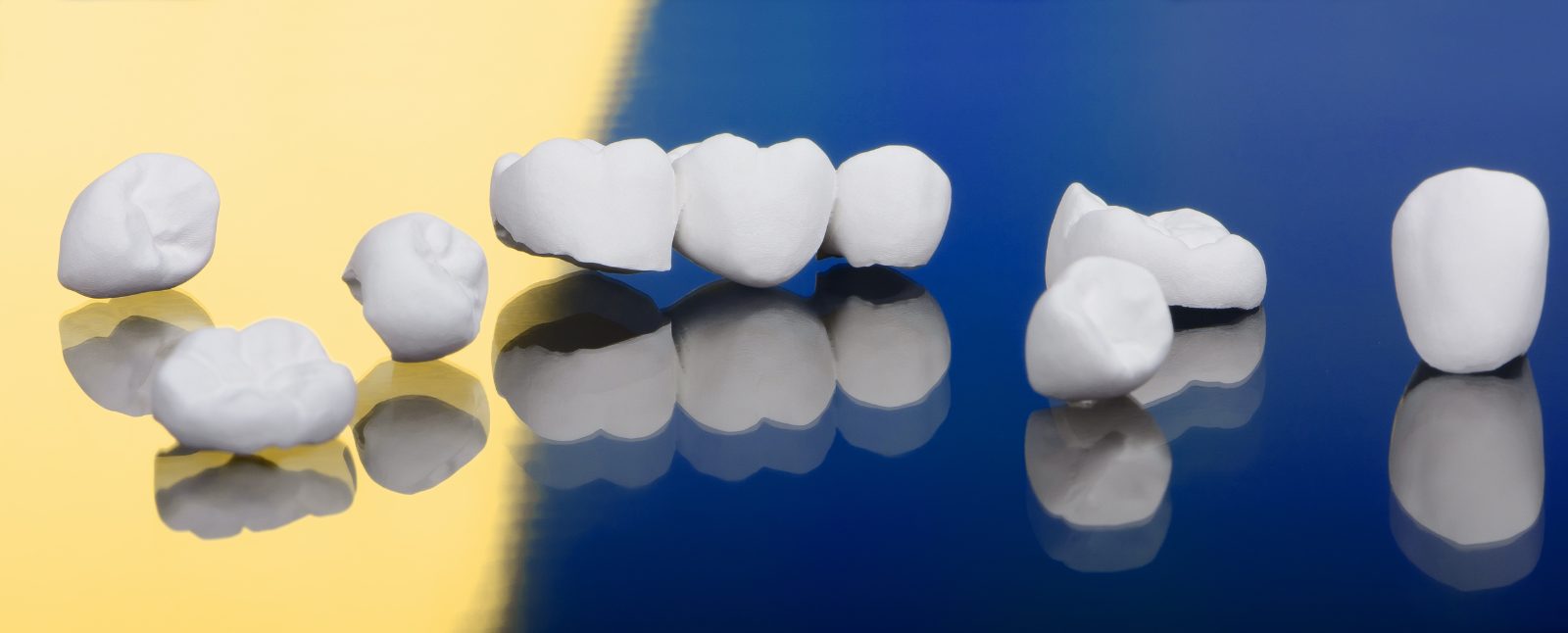
Zirconia, E.max, or PFM: What Your Crown Is Actually Made Of
Quick answer
Zirconia is the strongest of the common dental crown materials and is my first choice for back teeth that take heavy load. E.max (lithium disilicate) is the one I reach for when the crown has to disappear next to natural front teeth. PFM, a porcelain layer fused over a metal substructure, is still useful in a narrow set of cases, usually where a crown has to splint to older metal work already in the mouth. In practice the material is the last decision I make, not the first: how much sound tooth is left, where the tooth sits in your bite, and whether you grind at night all narrow the choice before material ever comes up.
The short version: three materials, three different jobs
Patients almost always arrive at this question from the wrong end. They have read that zirconia is the strongest, or that E.max looks the most natural, and they want to tell me which one to use. I understand the instinct — it feels like the one part of the process you can control. But picking a crown material in the abstract is a little like picking a tire without saying what you are driving or where.
Here is how I actually think about the three dental crown materials you are most likely to be offered. Zirconia is a dense ceramic that resists fracture better than anything else I place, which makes it my default for molars and for anyone whose bite does real damage. E.max — the brand name most people know for lithium disilicate — transmits light the way enamel does, so it is what I choose when the crown sits next to natural front teeth and has to be invisible. PFM, porcelain fused to metal, is the oldest of the three and the one I use least, but it has not disappeared, and there is a reason for that.
The rest of this post is the reasoning behind those three sentences, because the reasoning is what tells you whether the recommendation you got for your tooth makes sense.
What a crown actually is — and what it is not
A crown is not a filling and it is not a veneer. A filling replaces missing tooth structure from the inside. A veneer covers the front surface only. A crown wraps the whole tooth, above the gumline, and takes over the job of holding it together. The ADA’s MouthHealthy puts the purpose plainly: “A crown can make your tooth stronger and improve its appearance,” and it “can help strengthen a tooth with a large filling when there isn’t enough tooth remaining to hold the filling.”
That last clause matters more than the material conversation does. A crown is a structural decision first and a cosmetic one second. When I reduce a tooth for a crown I am building a foundation that has to resist being pried apart every time you chew, for years, in a wet environment, at body temperature, with a bacterial film forming on it continuously. The material has to survive that. So does the seam where it meets your tooth.
This is also why I will not quote you a material over the phone. Until I have looked at how much sound tooth is left, what the opposing teeth are doing, and whether the tooth has had a root canal, I am guessing. I wrote a whole post on the question that comes before this one — whether your tooth needs a crown, a filling, or an onlay at all — because getting that wrong makes the material question irrelevant. Material is also a separate decision from where the crown is made: whether it is milled in the office or made in a lab is a question about turnaround and about how the crown is shaped, not about what it is shaped from.
Zirconia: the strongest option, and where that strength earns its place
Zirconia is zirconium dioxide, a ceramic stabilised with yttria and milled from a solid blank. The version I use most is monolithic — the whole crown is one piece of zirconia, with no porcelain layered on top. That distinction is the single most important thing to understand about zirconia, and it is where most of the outdated advice about it comes from.
Older zirconia crowns had a strong zirconia core with cosmetic porcelain veneered over it. The core almost never broke. The porcelain on top chipped, and it chipped often enough that the systematic review literature of the 2010s treated zirconia as a second-tier choice for exactly that reason. Monolithic zirconia removed the layer that was failing. A prospective study of 50 monolithic zirconia crowns on premolars and molars, published in the Journal of Prosthodontic Research in 2021, reported a survival rate of 98% after five years, and the authors noted that “no fracture or fissures were detected” in any of the crowns over that period.
So when I recommend zirconia for a first molar, I am not reaching for the fashionable material. I am reaching for the one whose documented failure mode is not fracture. If you are a heavy chewer, if you have lost a crown on that side before, or if your bite closes with force you cannot feel, zirconia is where I start. The trade-off is optical: the most durable zirconia formulations are the least translucent, so on a front tooth standing alone next to natural enamel, a high-strength zirconia can read slightly flat in certain light.
E.max and lithium disilicate: when the crown has to disappear
Lithium disilicate is a glass ceramic, and glass is what gives enamel its particular behaviour in light. Enamel is not opaque and it is not clear; light enters it, scatters, and comes back out, which is why a natural tooth looks alive and a flat white crown next to it looks like a tooth-shaped object. Lithium disilicate does that scattering convincingly. It also bonds adhesively to tooth structure in a way zirconia does not, which means on a tooth with less remaining structure I can get real retention out of the bond itself rather than relying on wrapping geometry alone.
The honest limitation is load. Lithium disilicate is strong — strong enough for most premolars and plenty of molars in a normal bite — but it is not zirconia. The 2015 systematic review by Sailer and colleagues in Dental Materials, which pooled leucite and lithium-disilicate reinforced glass ceramic single crowns, reported five-year survival of 97.5% in the anterior region and 94.2% in the posterior. That gap is the whole story in two numbers: this material does its best work at the front of the mouth.
In practice that is exactly how I use it. Upper front teeth, canines, premolars where appearance still matters because you can see them when you laugh — E.max. A lower second molar on someone who clenches — never. And when a single front tooth needs a crown and the two beside it are untouched natural teeth, lithium disilicate is not a preference, it is close to a requirement, because matching a natural tooth is the hardest thing we do and the material has to help.
PFM: the old standard, and the one thing it still does well
Porcelain fused to metal was the workhorse of restorative dentistry for forty years, and it earned that. A cast metal shell takes the load, porcelain over the front of it supplies the appearance. Sailer’s review put five-year survival of metal-ceramic single crowns at 95.7%, essentially level with the all-ceramics, and concluded that “survival rates of most types of all-ceramic SCs were similar to those reported for metal-ceramic SCs.” PFM did not fall out of favour because it failed. It fell out of favour because of the margin.
Metal does not transmit light. Where a PFM crown meets the tooth at the gumline, there is an opaque edge, and when gum tissue recedes a millimetre or two over the following decade — which it tends to do — that edge shows as a grey line. Patients who had PFM crowns placed in their forties often come to me in their sixties about exactly that line, with the crown itself still perfectly sound.
I still use PFM in a narrow set of cases. When a crown has to connect to existing metal work — an older bridge, a partial denture with a precision rest seated on the crown — metal is the sensible substructure. When a tooth sits so far back that nobody will ever see it and the clearance to the opposing tooth is extremely tight, a metal occlusal surface can be made thinner than a ceramic one without risking fracture. Those are real situations. They are just not most situations, and if someone is offering you PFM for an upper front tooth in 2026, ask why.
What the research actually shows about how long each one lasts
If you want one table to carry away from this post, it is the five-year survival data from Sailer’s 2015 review in Dental Materials, which remains the most careful head-to-head synthesis of tooth-supported single crowns we have. Metal-ceramic came in at 95.7%. Leucite and lithium-disilicate reinforced glass ceramic, 96.6% overall. Densely sintered alumina, 96.0%. Veneered zirconia, 91.2%, and the review’s own recommendation was blunt about why: “zirconia-based SCs should not be considered as primary option due to their high incidence of technical problems.”
That quote is still circulating, and it is still being used to argue against zirconia crowns. It should not be, because it describes veneered zirconia — porcelain chipping off a zirconia core — and that is not the restoration I am placing. The monolithic data that came afterwards, including the 98% five-year survival in the 2021 Journal of Prosthodontic Research series, measures a different object. This is one of those places where the literature and current practice are genuinely out of step, and where reading a 2015 conclusion as 2026 advice will point you the wrong way.
The other thing those numbers show, which nobody finds satisfying, is that the differences between materials are small compared with the differences between mouths. Every one of those figures is above 90% at five years. The variance that actually determines whether your crown is still there in fifteen years is not the material. It is how much tooth was left underneath, how clean the margin stays, and what your bite does to it at night.
How much tooth is left still decides more than the material does
A crown needs something to hold on to. The technical term is ferrule — a continuous band of sound tooth structure above the gumline that the crown can encircle. With a good ferrule, almost any of these materials will serve you well. Without one, the best ceramic in the world is sitting on a post and a hope.
This is why the sequence of your treatment matters. If a tooth has had a root canal, it has lost internal structure as well as whatever decay or fracture took it there in the first place. That tooth is more brittle and it has less to grip, and it is the reason I do not consider a root-canalled tooth finished until the crown is on it. The material conversation on that tooth starts from a different place than it would on an intact tooth with a large old filling.
When the problem is bigger than one tooth — several crowns, worn-down bite, teeth that have drifted because of ones that are missing — then material becomes one variable in a larger plan about bite position and vertical height, and I plan it as a whole rather than tooth by tooth. For implant-supported crowns, the surgical placement is done by our periodontist; I plan the case and deliver the final restoration, and that final crown is usually zirconia for the same load reasons as anywhere else in the back of the mouth.
If you grind, the answer changes before we start
Bruxism is the single factor most likely to override everything else in this post. A patient who clenches at night can generate forces several times what normal chewing produces, applied for long stretches, with no protective reflex because they are asleep. I can see it in the flattened cusps, the shiny wear facets, the hairline cracks in enamel under transillumination, and the way a crown that should have lasted twenty years comes loose in four.
For a confirmed grinder, monolithic zirconia is close to the only answer I am comfortable with on a posterior tooth, and even then I will not place it without addressing the grinding itself. A crown placed into an untreated bruxism habit is a replacement part fitted to a machine that is still breaking parts. That usually means a night guard, and sometimes it means looking harder at why you are clenching — airway, stress, reflux, medications.
There is also an appearance consequence people do not anticipate. Grinders wear their own enamel down over years, so their natural teeth get shorter and more translucent at the edges. A new crown built to textbook dimensions in that mouth looks wrong because it is correct. Matching worn teeth is its own skill, and it is a conversation I would rather have before the tooth is prepared than after the crown is cemented.
The margin is the part nobody asks about — and it is where your health shows up
Every crown has a seam. It runs around the tooth at or just below the gumline, and it is the single most consequential millimetre of the whole restoration. A crown with a beautifully matched shade and an imperfect margin is a worse restoration than a plain-looking crown that seals. Plaque collects at a rough or open margin, and the tissue right beside it responds.
This is the point where a conversation about dental crown materials stops being about ceramics and becomes a conversation about your health. The ADA’s MouthHealthy is direct about the mechanism: “gum disease is caused by plaque, the sticky film of bacteria” that forms on teeth continuously, and the ADA notes that “some studies indicate that severe gum disease may be associated with several other health conditions,” while being appropriately careful that “research between systemic diseases and periodontal diseases is ongoing.” I take that association seriously in the chair without overstating it to you. Inflamed tissue bleeding around a crown margin is not a cosmetic complaint. It is an open inflammatory site in a body that has to deal with it.
I have watched this run both directions. Patients whose gum inflammation was finally taken seriously often report that other things got easier, and patients managing inflammatory conditions elsewhere in the body frequently have gums that tell the same story — which is why I have argued that a rheumatologist ought to be asking about a patient’s gums. Where a crown margin sits, how smoothly it is finished, and whether you can actually clean it are therefore clinical health decisions, not finishing touches. Zirconia and lithium disilicate both polish to a margin I trust. Whether you keep it clean after that is the part I cannot do for you, and it is why I want you back for hygiene visits on a real schedule rather than when something hurts.
A composite case: how the decision actually gets made
The following is a composite scenario. It is assembled from details common to several patients and does not represent any real individual’s identity, record, or history.
A woman in her late fifties comes in because a crown on her upper right first molar has come loose. It is a PFM crown placed about eighteen years ago. The crown itself is intact. Underneath it, the tooth has recurrent decay along the back margin, and there is less sound structure left than the radiograph first suggested. Two teeth forward, her upper right canine has a large old composite filling that is starting to fracture at the edges, and she mentions — almost as an aside — that she has started waking with a sore jaw.
Three teeth, three different answers. The molar gets monolithic zirconia: it is a load-bearing tooth, it has already lost one crown, and the remaining structure needs a material whose failure mode is not fracture. The canine gets lithium disilicate: it shows when she smiles, the tooth is largely intact so I can rely on an adhesive bond, and the load there is oblique rather than crushing. And the sore jaw changes the sequence entirely — before either crown is permanently cemented, we work up the grinding, because placing both into an untreated clenching habit would be fitting new parts to a mechanism still doing damage. If sitting through two longer appointments is the obstacle, that is a solvable problem rather than a reason to postpone.
Notice that at no point in that reasoning did I start from the material. I started from how much tooth was left, what each tooth has to do, and what her bite is doing to all of it. The materials fell out of those answers.
What I need from you before I can pick a material
Four things, and none of them require you to know any dentistry. First, tell me whether you wake with a sore jaw, a headache in your temples, or teeth that feel tender to bite on in the morning — that is grinding, and it reorders everything. Second, tell me whether you have lost a filling or a crown on that tooth or its neighbours before, because a repeat failure in one area is information about force, not bad luck.
Third, tell me honestly how much the appearance of that specific tooth matters to you. People are strangely reluctant to say “I can see this tooth and I care how it looks,” as though it were a frivolous thing to want. It is not frivolous and it changes my material choice. Fourth, tell me what your medical picture looks like right now — conditions you are managing, medications you take, anything that has changed since your last visit. Dry mouth from a new medication raises decay risk at the margin, and a clotting or cardiac consideration can change how I sequence longer appointments.
And if what is actually standing between you and a tooth that has needed attention for two years is dread rather than scheduling, say that out loud. We do sedation in this office precisely so that the people who avoid dentistry for years do not have to keep avoiding it, and for patients with medical conditions there is a clearance conversation I would rather have in advance than on the morning of.
Frequently asked questions about dental crown materials
Which dental crown material is the strongest?
Zirconia, and by a clear margin. Monolithic zirconia — where the entire crown is milled from one piece rather than having porcelain layered over a core — resists fracture better than lithium disilicate or porcelain-fused-to-metal. A five-year prospective series published in the Journal of Prosthodontic Research in 2021 found 98% survival with no crown fractures or fissures detected. That is why zirconia is my default for molars and for anyone with a heavy bite. Strength is not the only consideration, though: the most fracture-resistant zirconia formulations are also the least translucent, which is why I do not automatically use it on front teeth.
Is E.max as strong as zirconia?
No, and it does not need to be for the teeth it is best suited to. E.max is a brand of lithium disilicate, a glass ceramic that is strong enough for front teeth, canines and most premolars in a normal bite, and it bonds adhesively to tooth structure in a way that adds real retention. The 2015 systematic review in Dental Materials reported five-year survival of 97.5% for this class of glass ceramic in the front of the mouth versus 94.2% in the back — a gap that tells you exactly where it belongs. I use it where appearance is the governing requirement and the load is manageable, and I do not use it on a lower second molar for someone who clenches.
Do PFM crowns still make sense in 2026?
In a narrow set of cases, yes. Porcelain-fused-to-metal has survival data essentially level with the all-ceramics — 95.7% at five years in the Sailer review — so it did not fall out of favour because it failed. It fell out of favour because metal does not transmit light, so the margin at the gumline can show as a grey line if the gum recedes over the following decade. I still choose PFM when a crown has to connect to existing metal work such as an older bridge or a partial denture rest, or where clearance to the opposing tooth is so tight that a thin metal biting surface is safer than ceramic. For an upper front tooth, I would want a clear reason.
Will a zirconia crown wear down the tooth that bites against it?
This worried the profession when zirconia first became common, and the answer turned out to depend almost entirely on surface finish rather than on the material itself. A well-polished zirconia surface is kind to the opposing tooth; a rough or unpolished one is abrasive. So when I place zirconia I polish the biting surface properly and I check it again at your next visit, because a crown that was adjusted at delivery and never re-polished is the version that causes trouble. If you grind, I also want a night guard in place, which protects the opposing tooth far more than any material choice does.
How long should a crown last?
The honest answer is that the material is not the main variable. Every material discussed here sits above 90% survival at five years in the published literature, and the differences between them are small compared with the differences between mouths. What determines whether your crown is still serving you in fifteen or twenty years is how much sound tooth was left underneath it, whether the margin stays clean, and what your bite does to it at night. I have removed sound twenty-year-old crowns because the tooth beneath them decayed, and I have replaced four-year-old crowns on untreated grinders. Hygiene visits and a night guard do more for longevity than upgrading the ceramic.
Can you tell a crown is there just by looking at it?
With lithium disilicate on a well-matched single front tooth, usually not — that is the whole reason I use it there. With monolithic zirconia on a molar, nobody is looking, so it does not matter. The giveaways people notice on older crowns are a grey line at the gumline, which is the opaque metal margin of a PFM crown showing after gum recession, and a crown that is too uniformly white or too flat against its neighbours. Matching a single tooth beside two untouched natural teeth is the hardest thing we do in restorative dentistry, and it is as much about shaping surface texture and translucency at the edge as it is about shade.
Can I choose my own crown material?
You get a real say, and I would rather you had one. What I will not do is place a material I think will fail on your tooth. If you want lithium disilicate on a lower molar and I can see wear facets that tell me you clench, I will explain what I expect to happen and offer zirconia instead — and if appearance is the reason you are asking, there are often ways to meet that concern without putting the restoration at risk. Bring me the priority that matters most to you, whether that is appearance, durability, or how little tooth you want removed, and the material will follow from your tooth and your priority together.
Where to start
If a crown on one of your teeth has fallen off or come loose, if an old one is showing a dark line at the gumline, or if you have been told you need a crown and want to understand the choice before you are in the chair, that is a conversation worth having properly rather than in the ten minutes before the handpiece comes out.
You can see how we approach crowns on our dental crowns page, or reach the office directly. We are at 572 E McNab Rd, Suite 102, Pompano Beach, FL 33060, and you can call (954) 785-1100. Our hours are Monday 8:30 AM to 12:30 PM, Tuesday 8:00 AM to 5:00 PM, Wednesday 8:30 AM to 12:30 PM, Thursday 9:30 AM to 6:30 PM, and Friday 8:00 AM to 5:00 PM. We are closed Saturday and Sunday.
Bring the four things I asked for above. I will bring the tooth.
South Florida Smile Spa · 572 E McNab Rd, Suite 102, Pompano Beach, FL 33060 · (954) 785-1100
References
- ADA MouthHealthy — Crowns
- ADA MouthHealthy — Gum Disease (Periodontal Disease)
- Sailer I, Makarov NA, Thoma DS, Zwahlen M, Pjetursson BE. All-ceramic or metal-ceramic tooth-supported fixed dental prostheses? Part I: Single crowns. Dental Materials 2015;31:603–623
- Prospective study of monolithic zirconia crowns: clinical behavior and survival rate at a 5-year follow-up. Journal of Prosthodontic Research 2021;65(3):284–290

Dr. Nicole M. Berger, DDS
Dr. Berger has cared for patients in Pompano Beach for over two decades at South Florida Smile Spa, with a focus on cosmetic dentistry, implants and reconstruction, and sedation options for anxious patients.