


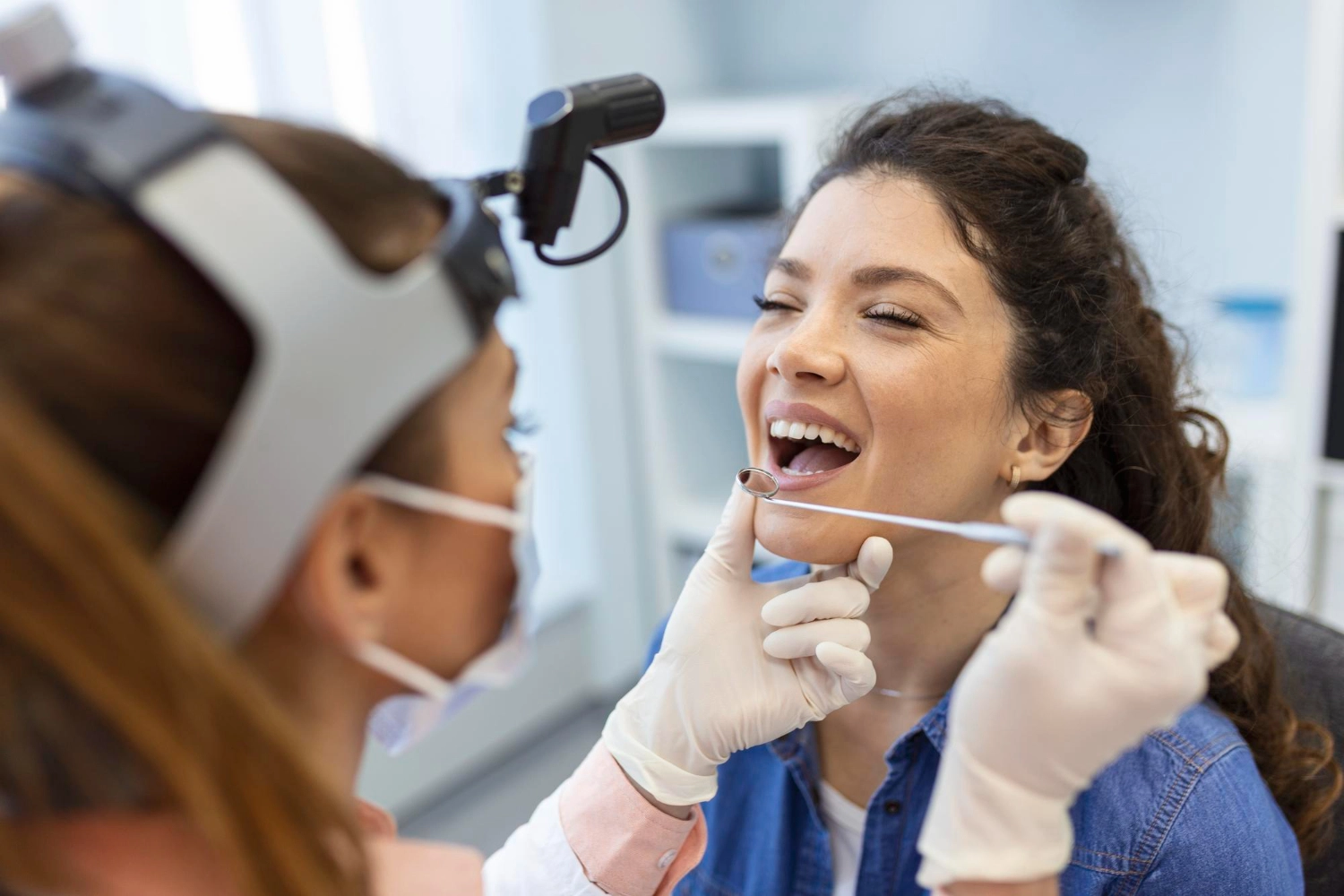
Oral Health During Cancer Treatment: What I Want Every Patient to Do Before, During and After
Quick answer: oral health during cancer treatment
Oral health during cancer treatment starts before the first dose. The National Cancer Institute recommends a dental checkup at least four weeks before treatment begins, so that infected teeth, failing fillings and gum disease can be treated and healed while your immune system is still strong. Nearly all head and neck radiation patients, about 80 percent of stem cell transplant recipients and roughly 40 percent of chemotherapy patients develop mouth problems: sores, dry mouth, infection, rapid decay and jaw stiffness. Most are predictable, and the worst of them are preventable with a pre-treatment exam, custom fluoride trays, a gentle daily routine and a dentist who coordinates with your oncology team. Dr. Nicole M. Berger, DDS provides this care at South Florida Smile Spa in Pompano Beach.
By Dr. Nicole M. Berger, DDS · South Florida Smile Spa, Pompano Beach
When someone is told they have cancer, the mouth is the last thing on their mind. I understand that completely. There is a surgeon to meet, a treatment plan to absorb, work and family to rearrange. Nobody is thinking about a molar with an old filling or gums that bleed a little when they floss.
And yet the mouth is one of the first places cancer treatment shows up, and one of the few places where a little preparation changes the whole experience. I have sat with patients who sailed through chemotherapy with nothing worse than a few days of tenderness, and I have sat with patients whose treatment had to be paused because an infection in a tooth nobody looked at became an infection in a body that could no longer fight it. The difference between those two stories is almost never luck. It is whether anyone thought about oral health during cancer treatment before the treatment started.
This post is what I tell patients and their families at that first visit. It is written for the person who has just been diagnosed, for the spouse or adult child doing the research, and for anyone already in treatment who is wondering whether what is happening in their mouth is normal and what to do about it.
Why cancer treatment reaches the mouth at all
Chemotherapy works by attacking cells that divide quickly. Cancer cells divide quickly, which is the point. So do the cells lining your mouth, the cells that make saliva, and the white blood cells that police bacteria. The lining of the mouth renews itself roughly every two weeks, which makes it one of the fastest-turnover tissues in the body and one of the first casualties when that turnover is interrupted.
Radiation to the head and neck is more direct. If the salivary glands sit in the beam’s path, they are damaged, often permanently. The jawbone in the field loses some of its blood supply and its ability to heal. The muscles that open the jaw can scar and tighten. None of that is a side effect in the loose sense of the word; it is the expected biology of treating a tumor near the mouth, and it is why a head and neck radiation plan should always include a dentist.
The numbers are not small. According to the National Institute of Dental and Craniofacial Research, “Oral complications occur in virtually all patients receiving radiation for head and neck malignancies, in approximately 80 percent of hematopoietic (bloodforming) stem cell transplant recipients, and in nearly 40 percent of patients receiving chemotherapy.” That is not a reason for alarm. It is a reason to plan.
The single most important appointment: the one before treatment
If you take one thing from this post, take this. The American Dental Association’s MouthHealthy guidance on cancer and dental health states it plainly: “The NCI recommends a dental checkup at least four weeks before you start treatment.” The NIDCR says the same thing from the clinical side: “Ideally, a comprehensive oral evaluation should take place 1 month before cancer treatment starts to allow adequate time for recovery from any required invasive dental procedures.”
Why a month? Because anything I find that needs to come out or be fixed has to heal before your immune system is suppressed or before your jaw is irradiated. An extraction socket that would close uneventfully in a healthy patient can become a non-healing wound in a jaw that has been through radiation. The NIDCR’s instruction to dentists is specific: “Time oral surgery to allow at least 2 weeks for healing before radiation therapy begins.” A month gives us that margin with room to spare.
Here is what that pre-treatment visit looks like in my office. I take a full set of X-rays, and for head and neck cases I use our in-house cone beam CT so I can see the roots and the bone in three dimensions. I check every tooth for decay, cracks and failing restorations. I measure the gums for periodontal disease, because deep infected pockets are a reservoir of bacteria that will matter enormously when your white cell count drops. I look at any teeth that are already questionable, and I make a decision about each one: treat it now, remove it now, or leave it and watch it. Then I write to your oncologist, because the treatment schedule and the dental schedule have to be built together.
Routine extractions and periodontal cleaning I do here. Complex surgical extractions, or many teeth at once, I refer to an oral surgeon so they are done quickly and well. The point is not who does the work. The point is that it is done, and healed, before day one of treatment.
What chemotherapy does to the mouth, and what I do about it
Mouth sores (oral mucositis). This is the most common and the most miserable complication. The lining of the mouth thins, reddens and ulcerates, usually within the first two weeks of a chemotherapy cycle, and heals as your counts recover. Eating hurts, speaking hurts, and in severe cases patients cannot swallow their own saliva. The 2020 clinical practice guidelines from the Multinational Association of Supportive Care in Cancer and the International Society of Oral Oncology, published in Cancer, support three things I want every patient to know about: basic oral care done consistently, oral cryotherapy (holding ice chips in the mouth during certain short chemotherapy infusions, which constricts the blood vessels in the lining and reduces the drug’s exposure there), and photobiomodulation, a low-level light therapy that some cancer centers offer to prevent mucositis. Your oncology team decides which of these fits your regimen; my job is to make sure your mouth is as healthy as possible going in, because a mouth with no sharp edges, no infected gums and no rough fillings gets fewer sores and heals faster.
Infection. When your white cell count falls, the ordinary bacteria and yeast in your mouth become opportunists. A tooth with a small abscess that your body was quietly containing can flare. Thrush, the white patches of a yeast overgrowth, becomes common. Cold sores reactivate. This is why I am so insistent about the pre-treatment visit: I would far rather treat a dental infection in a patient with a normal immune system than in a patient whose counts are at their lowest.
Bleeding. Chemotherapy lowers platelets, the cells that stop bleeding. Gums that bleed slightly when brushing can bleed persistently. This is not a reason to stop brushing, which I will come back to. It is a reason to brush gently with the right tool, and a reason I will not do anything invasive without your most recent blood counts in front of me. The NIDCR guidance I follow is to “Postpone oral surgery or other oral invasive procedures if: platelet count is less than 75,000/mm3 or abnormal clotting factors are present.” Your oncologist and I check this together, every time.
Dry mouth and taste changes. Chemotherapy often reduces saliva and changes how food tastes; metallic and bitter flavors are the usual complaints. Both generally improve after treatment ends. The dry mouth matters more than people expect, and I explain why below.
What head and neck radiation does, and why it is different
Everything above applies to radiation too, but radiation adds three problems that chemotherapy does not, and two of them are permanent.
Permanent dry mouth (xerostomia). When the salivary glands are in the treatment field, they are damaged and often do not recover. Saliva is not just moisture. It buffers acid, washes away food, carries the minerals that repair early enamel damage, and keeps bacteria and yeast in check. Take it away and teeth that were healthy for fifty years can develop decay at the gumline of nearly every tooth within a year or two. Dentists call it radiation caries, and it is one of the most aggressive patterns of decay I ever see.
The defense is fluoride, delivered in a way that ordinary toothpaste cannot match. The NIDCR recommends that “a high-potency fluoride gel, delivered via custom gel-applicator trays, is recommended. Several days before radiation therapy begins, patients should start a daily 10-minute application of a 1.1% neutral pH sodium fluoride gel or a 0.4% stannous fluoride (unflavored) gel.” I make those trays at the pre-treatment visit, from a scan of your teeth, and you take them home with the prescription gel before radiation starts. This is a lifelong habit, not a treatment-phase habit, because the dry mouth does not end when the radiation does.
Osteoradionecrosis. Irradiated jawbone loses blood supply. If a tooth is extracted from that bone later, the socket may never heal and the bone itself can die and become exposed. This is the reason questionable teeth in the radiation field come out before treatment rather than after. The ADA’s current clinical summary puts the prevalence in the range of 2 to 15 percent of head and neck radiation patients, and notes it can appear months or years after treatment. Every dentist you see for the rest of your life needs to know you had head and neck radiation, and which side.
Trismus. The muscles that open the jaw can scar and tighten, and a mouth that only opens two fingers wide is hard to clean and hard to treat. The NIDCR’s advice is simple and I give it to every radiation patient: open and close the mouth as far as possible 20 times, three times a day, starting before treatment and continuing after. It is the least glamorous exercise in medicine and it works.
A note on bone-strengthening drugs and the jaw
Many patients with breast cancer, prostate cancer, multiple myeloma or cancer that has spread to bone receive drugs that strengthen bone and reduce fractures: zoledronic acid, denosumab and related medications. At the doses used in cancer care, these carry a small but real risk of medication-related osteonecrosis of the jaw, in which bone is exposed in the mouth and fails to heal, most often after an extraction. The risk at cancer doses is substantially higher than at the much lower doses used for osteoporosis.
The American Association of Oral and Maxillofacial Surgeons’ 2022 position paper is clear that the best protection is a dental evaluation before these drugs start, with any extractions completed and healed first. So if your oncologist mentions a bone-strengthening infusion or injection, ask for a dental visit before the first dose, exactly as you would before radiation. If you are already on one, tell me, because it changes how I plan anything that touches bone.
Oral health during cancer treatment at a glance
| Phase | What is happening | What to do |
|---|---|---|
| 4+ weeks before | Immune system and jaw still healthy; last window for invasive work | Comprehensive exam and X-rays; treat decay and gum disease; remove hopeless teeth; make fluoride trays; dentist writes to oncologist |
| During chemotherapy | Counts fall and recover in cycles; sores, infection, bleeding, dry mouth | Soft brush twice daily; baking soda and salt rinse; no alcohol mouthwash; report sores and white patches; no invasive dental work without current blood counts |
| During radiation | Saliva declining; mucositis building week by week; jaw muscles tightening | Daily fluoride tray; jaw-opening exercises; moisten constantly; bland soft diet; tobacco and alcohol off entirely |
| After treatment | Chemo effects resolve over weeks; radiation dry mouth and bone changes are permanent | Return visit at 4 to 8 weeks; cleanings every 3 to 4 months; lifelong fluoride after radiation; tell every future dentist about your treatment |
The daily routine I give every patient in treatment
Keep brushing. I say this first because frightened patients stop, and stopping is the worst thing you can do. Plaque that sits on sore gums makes the soreness worse and feeds the bacteria you can least afford. Use the softest toothbrush you can find, or an ultra-soft brush softened further under warm water, and brush gently after every meal and before bed. If your platelets are very low and your oncology team tells you to pause brushing, use a foam swab instead, and go back to the brush as soon as they clear you.
Rinse often, with the right thing. The NIDCR’s recipe is the one I hand out: “Rinse the mouth with a baking soda and salt solution, followed by a plain water rinse several times a day. (Use ¼ teaspoon each of baking soda and salt in 1 quart of warm water.)” It neutralizes acid, soothes the lining and is as simple as it gets. Put every mouthwash that contains alcohol in a drawer until treatment is over; it stings and dries an already dry mouth.
Floss gently if your gums are not bleeding on their own and your team has not told you to stop. Skip any spot that is sore or ulcerated and come back to it when it heals.
Keep the mouth moist. Sip water constantly, hold ice chips, use sugar-free gum or lozenges, and use a saliva substitute at night if you wake up with your tongue stuck to the roof of your mouth. Avoid anything sharp, crunchy, hot or spicy while sores are present, and avoid tobacco and alcohol completely.
If you wear dentures, clean them daily, take them out at night, and leave them out entirely while the mouth is ulcerated. The NIDCR notes that “Dentures may need to be reconstructed if treatment altered oral tissues,” and some patients find a denture that fit perfectly before treatment never fits comfortably again. Tell me if that happens; there are solutions, and suffering through it is not one of them.
When to call me, and when to call your oncologist
Call my office the same day for a toothache, a loose or broken tooth or filling, swelling of the gum or face, a sore that has not improved in two weeks, or a denture that is rubbing a raw spot. During treatment I keep time for these calls, because small problems in a patient with suppressed immunity do not stay small, and our same-day emergency care exists for exactly this.
Call your oncologist first, and then me, for a fever, mouth sores severe enough that you cannot drink, bleeding from the mouth that does not stop with gentle pressure, or white patches spreading across the tongue and cheeks. Those are signs that your counts or your infection risk need to be assessed before anything is done in the mouth.
A representative case: the molar that would have paused chemotherapy
The following is a composite scenario, a blend of details from many patients. It is not a real individual and not a testimonial.
A woman in her early sixties came to me three weeks before her first chemotherapy infusion for breast cancer. Her oncologist’s nurse had told her to “get a dental clearance,” and she arrived mildly annoyed about it. She felt fine. Her teeth did not hurt.
Her X-rays showed a lower molar with a deep old filling and a dark shadow at the tip of one root: a chronic, painless infection her immune system had been holding in check for years. In a healthy patient, that tooth would have been a root canal on a convenient Tuesday. In a patient three weeks from chemotherapy, it was a decision. The tooth had enough structure to save, so I completed the root canal that week, placed a protective restoration, and wrote to her oncologist confirming she was clear to start on schedule. We also made her a set of fluoride trays, because her treatment plan included a drug known to cause dry mouth, and I measured and recorded her gum pockets so I would have a baseline.
She developed mucositis in her second cycle, as many patients do. It was uncomfortable, but it was uncomplicated: no infection, no fever, no delay. She told me afterward that the baking soda rinse was the single most useful thing anyone gave her during treatment, which is a humbling thing for a dentist with a cone beam scanner to hear. Had that molar flared during her lowest counts, the likeliest outcome was a hospital admission for intravenous antibiotics and a delayed cycle. Instead it was a non-event, which is what good preparation is supposed to look like.
Where sedation fits for patients in treatment
Some patients arrive at the pre-treatment visit needing more dental work than they expected, on a deadline, at the most stressful moment of their lives. Completing several extractions, a deep cleaning and a few fillings in one visit under IV or oral sedation is often the kindest and the most practical way to get everything healed before treatment begins. For patients with longstanding dental anxiety, it can be the difference between getting cleared and not showing up.
Sedation in a cancer patient is planned with the oncologist, not around them. I need your full medication list, including every chemotherapy, immunotherapy and supportive drug, your most recent blood counts, and your oncologist’s agreement on timing. I have written separately about what I need to know about your medications before sedation, and for patients in cancer treatment every item on that list matters more, not less.
After treatment: the mouth remembers
For chemotherapy patients, most oral effects resolve within weeks of the final cycle. Taste returns, saliva returns, the lining heals. I like to see patients four to eight weeks after they finish, to repair anything that chipped or decayed during treatment and to reset the cleaning schedule, usually to every three or four months for the first year.
For head and neck radiation patients, the dry mouth and the fragile bone are usually permanent, and dental care becomes a lifelong partnership. The fluoride trays continue indefinitely. Cleanings stay frequent. Any future extraction in the irradiated field is planned carefully, sometimes with an oral surgeon and sometimes with hyperbaric oxygen beforehand. Dental implants in irradiated bone are possible in selected cases, placed by our periodontist after a careful review of the radiation dose and field; I plan those cases and deliver the final restorations, and I am honest with patients about when the risk is not worth it.
And for every cancer survivor, regardless of treatment, I do an oral cancer screening at every visit. Survivors of one cancer, and especially those who used tobacco or alcohol, carry a higher risk of a second one, and the mouth is a place where a dentist can find it early.
Why your mouth is part of your cancer care, not a detour from it
I write often about the ways the mouth and the body are one system: how gum disease and heart disease travel together, how diabetes and oral health feed each other, how rheumatoid arthritis and the gums share an inflammatory thread. Cancer treatment is where that connection stops being a topic for a blog post and becomes a matter of whether your treatment stays on schedule.
A mouth that is too sore to eat undermines the nutrition your body needs to tolerate treatment and rebuild; I have written about how chewing shapes what we eat, and in a cancer patient that link is immediate. An infection in a tooth is a doorway to the bloodstream in a patient whose immune system has been deliberately dialed down. A jaw that will not heal is a lifelong problem that one timely extraction could have prevented. The ADA’s MouthHealthy guidance is right that chemotherapy “can reduce your body’s ability to fight infection,” and the mouth, with its billions of bacteria, is where that reduced ability is tested first.
So when your oncology team tells you to see a dentist, please do not treat it as one more item on an exhausting list. Treat it as part of the treatment. It is.
Frequently asked questions: oral health during cancer treatment
How long before cancer treatment should I see a dentist?
At least four weeks before your first chemotherapy dose or radiation session, and ideally a full month. That window allows any extractions, root canals or gum treatment to heal while your immune system is still strong and, for head and neck radiation, before the jawbone loses its ability to heal. If treatment has to start sooner, see a dentist anyway; even a few days allows a cleaning, a fluoride plan and a note to your oncologist about anything that needs watching.
Can I have dental work done during chemotherapy?
Routine care such as exams and gentle cleanings can usually be done, timed to the part of your cycle when your blood counts are highest, with your oncologist’s agreement. Invasive work such as extractions is postponed when platelets are low or white cells are suppressed, because of the risk of bleeding and infection. Any dental treatment during chemotherapy is coordinated with your oncology team and planned around your most recent blood counts.
What helps mouth sores from chemotherapy?
Consistent gentle oral care is the foundation: a very soft toothbrush after meals and before bed, and a rinse of a quarter teaspoon each of baking soda and salt in a quart of warm water several times a day. Avoid alcohol-containing mouthwash and sharp, hot, spicy or acidic foods. Your oncology team may offer ice chips during certain infusions, low-level light therapy, or prescription rinses and pain relief. Call your oncologist if sores keep you from drinking fluids or are accompanied by fever.
Why does radiation to the head and neck cause so much tooth decay?
Because it damages the salivary glands, often permanently. Saliva neutralizes acid, washes away food, repairs early enamel damage with minerals and controls bacteria. Without it, decay develops rapidly at the gumline of many teeth at once, a pattern called radiation caries. Daily use of prescription-strength fluoride gel in custom trays, started before radiation and continued for life, is the main defense, along with frequent cleanings and constant moisture.
Can I get a tooth pulled after head and neck radiation?
Sometimes, but it is a decision made carefully, because irradiated jawbone has reduced blood supply and an extraction socket may not heal, a condition called osteoradionecrosis. This is why questionable teeth in the radiation field are usually removed before treatment rather than after. If an extraction is needed later, it is planned with knowledge of your radiation dose and field, often with an oral surgeon and sometimes with hyperbaric oxygen therapy beforehand. Always tell every dentist that you had head and neck radiation.
Should I see a dentist before starting bone-strengthening drugs like zoledronic acid or denosumab?
Yes. At the doses used in cancer care, these medications carry a risk of medication-related osteonecrosis of the jaw, in which bone becomes exposed in the mouth and does not heal, most often after an extraction. The American Association of Oral and Maxillofacial Surgeons recommends a dental evaluation before these drugs start, with any extractions completed and healed first. If you are already taking one, tell your dentist before any procedure that involves bone.
Is it safe to brush my teeth during cancer treatment?
Yes, and it is important to keep doing it. Stopping lets plaque build on already-sore gums and feeds the bacteria you can least afford. Use the softest brush available, brush gently after meals and before bed, and rinse with the baking soda and salt solution. If your platelets fall very low and your oncology team asks you to pause brushing, use a foam swab temporarily and return to the brush as soon as they clear you.
Starting treatment soon? Start here.
If you or someone you love has a cancer treatment date on the calendar, the dental visit belongs on that calendar too, four weeks ahead if at all possible. Tell our front desk you are preparing for cancer treatment and we will prioritize the appointment and coordinate directly with your oncology team.
Or call (954) 785-1100 · 572 E McNab Rd, Suite 102, Pompano Beach, FL 33060
Dr. Nicole M. Berger, DDS practices at South Florida Smile Spa, 572 E McNab Rd, Suite 102, Pompano Beach, FL 33060, and welcomes patients from Pompano Beach, Fort Lauderdale, Deerfield Beach, Lighthouse Point and Coconut Creek.
This article is for general education and is not a substitute for individual examination, diagnosis, or treatment planning. Dental care before, during and after cancer treatment must be coordinated with your oncology team, and decisions about specific teeth can only be made after an in-person examination.

Dr. Nicole M. Berger, DDS
Dr. Berger has cared for patients in Pompano Beach for over two decades at South Florida Smile Spa, with a focus on cosmetic dentistry, implants and reconstruction, and sedation options for anxious patients.


