

Root Canal vs Dental Implant in Pompano Beach: How a Dentist Decides Whether a Tooth Can Be Saved
By Dr. Nicole M. Berger, DDS — South Florida Smile Spa, Pompano Beach
Quick answer
Root canal vs dental implant in Pompano Beach comes down to one thing: a root-canal-treated tooth that is properly crowned and an implant-supported crown survive at nearly the same rate past six years — roughly 97% each. So the real question is not which treatment is better. It is whether your specific tooth can be predictably restored: whether enough sound tooth structure remains above the bone, whether the root is cracked, and whether the supporting bone is healthy. A vertical root fracture is the clearest reason a tooth cannot be saved. Cone beam 3D imaging is what answers those questions reliably, and it changes the plan in both directions more often than patients expect.
A patient sat in my chair last spring and said something I hear more and more: “Just pull it and give me an implant. I’d rather do it once and be done.”
I understood exactly what he meant. Implants have a reputation for being permanent, modern, and final — and root canals have a reputation for being miserable and for failing later anyway. If that were an accurate picture, his logic would be sound.
It isn’t accurate. And root canal vs dental implant is not really a question of which treatment is better, because that question has no general answer. It is about whether your tooth, specifically, can be predictably restored. Here is how that gets decided.
Root canal vs dental implant: what the long-term data actually shows
A systematic review by Torabinejad and colleagues compared long-term outcomes across three paths for a compromised tooth: root canal treatment with a proper restoration, extraction followed by an implant-supported single crown, and extraction followed by a fixed bridge.
At six years and beyond, weighted survival came out like this:
- Root canal treatment and restoration — 97%
- Implant-supported single crown — 97%
- Fixed bridge — 82%
Read that again, because it upends the assumption most patients arrive with. A properly treated and properly restored root canal tooth survives at the same rate as an implant. Both substantially outperform cutting down the neighboring teeth for a bridge.
Two honest footnotes. First, “success” is defined differently for each treatment, so the success numbers — 95% for implants, 84% for root canals — are not comparing quite the same thing. Survival is the cleaner comparison, and on survival, they tie. Second, the reviewers themselves flagged that direct head-to-head comparisons in the underlying studies were rare and the evidence quality was limited. I cite this because it is the most-referenced comparison available, not because it settles the question — which is precisely why the decision has to be made tooth by tooth rather than from a table.
So no — a root canal is not the inferior option, and an implant is not automatically the durable one.
The real question: can this tooth be restored?
When I evaluate a tooth, I am answering one question in five parts.
1. Is there enough tooth structure left above the bone?
This is the one patients never anticipate and the one that decides most cases. A crown needs a collar of solid tooth structure to grip — clinicians call it a ferrule. Without it, the crown has nothing to hold onto, and the restoration fails no matter how flawless the root canal was.
A tooth broken off at or below the gumline often cannot provide that. Sometimes we can gain it surgically. Sometimes we cannot.
2. Is the root cracked?
A vertical root fracture — a crack running lengthwise down the root — is the clearest “no” in dentistry. There is no repair. The tooth comes out.
The frustrating part is that these cracks frequently do not appear on a standard X-ray. Sometimes we only confirm one after opening the tooth. This is why I will occasionally tell a patient we are going to start treatment and reassess — not indecision, but the honest limit of what imaging can show.
3. Is the foundation healthy?
A tooth with advanced gum disease and bone loss around it may be perfectly treatable from the inside and still be loose in three years. The best root canal in the world cannot fix the ground the tooth stands in.
4. What does the 3D imaging show?
We have a cone beam CT scanner here in the office, so this happens at the same visit rather than as a referral. The scan shows root anatomy, the extent of infection, how much bone is actually there, and where the nerve and sinus sit. It changes the plan more often than patients expect — in both directions. I have scanned teeth that looked hopeless and found them restorable, and scanned teeth that looked simple and found a fracture.
5. What is the tooth’s job?
A molar doing heavy chewing work in a patient who clenches faces different forces than a tooth that mostly holds space. Grinding habits, medical history, smoking, diabetes control and bone quality all shape how each option is likely to perform for that individual.
Who does what at our practice
Patients ask this constantly, and it is a fair question to ask before you agree to anything. Here is the honest answer.
I perform root canal treatment here. Most cases are straightforward enough that I treat them myself, at this office, usually alongside the crown that has to follow. When a tooth has unusual canal anatomy, a previous root canal that needs redoing, or a calcified root that really needs a microscope and a specialist’s hands, I refer to an endodontist. Knowing which category a tooth falls into is part of the diagnosis, not an afterthought — and telling you which one yours is should happen before treatment starts, not during.
Implants are placed here too, by our periodontist. She handles the surgical side. I plan the case — deciding whether the tooth can be saved in the first place, where an implant needs to sit, and how the final restoration has to function in your bite — and I build and place the crown that goes on top. You are treated in one office by one team that talks to each other, rather than being handed between practices with your records trailing behind you.
I mention all of this for a specific reason. I am not the person who bills the surgical placement of an implant. So when I tell you a tooth is worth keeping, there is nothing riding on it except whether I am right.
What an implant genuinely does better
Implants are a real answer and I recommend them without hesitation where they are the right call. Where they clearly are:
- The tooth is already gone, or is unrestorable for the reasons above.
- The tooth has failed repeatedly. A tooth that has had root canal treatment, retreatment, and an apicoectomy has had its chances.
- The neighboring teeth are healthy. An implant stands alone. A bridge means grinding down two intact teeth to save one — and that is the option with 82% survival. If you are choosing between an implant and a bridge, that comparison is worth reading.
- The bone is good, or can be made good. When it isn’t, that’s a solvable problem more often than people assume — see what happens when there isn’t enough bone.
An implant will never decay. That is a real advantage, and for a patient with a high cavity rate it can be decisive.
What a natural tooth does better
This is the side that rarely gets argued, so let me argue it.
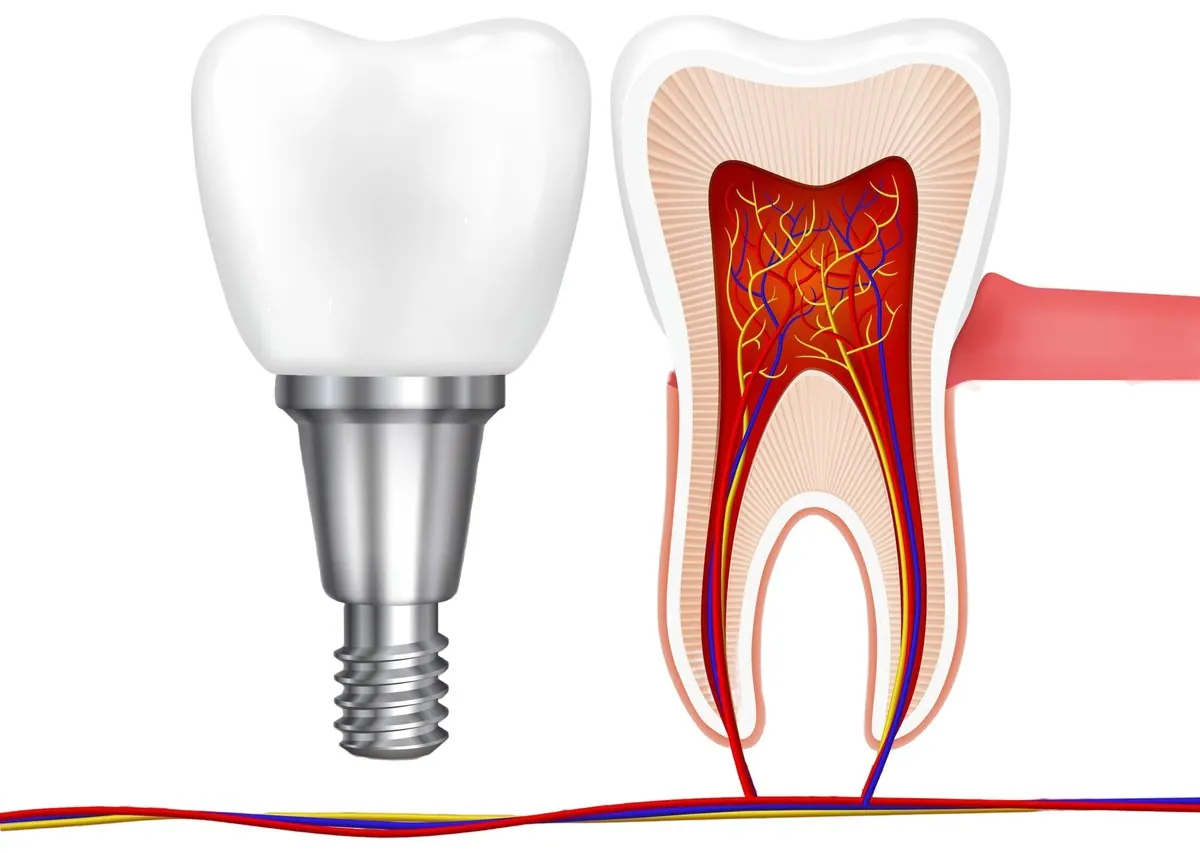
Your tooth has a ligament. An implant does not. The periodontal ligament suspends a natural tooth in bone, absorbs and distributes force, and — this is the part people underestimate — gives you proprioception. It is how you feel a popcorn kernel before you break something on it. An implant is fused directly to bone. It works, but it does not feel, and it does not cushion.
Bone behaves differently around a natural root. Extraction begins bone remodeling immediately, which is why grafting is so often part of the plan.
Implants are not immune to disease. Peri-implantitis — inflammation and bone loss around an implant — is real and increasingly common. The gum tissue around an implant is less resistant to bacteria than the tissue around a natural tooth. An implant is not a maintenance-free part.
The sequence is shorter. A root canal and crown is typically a matter of weeks. An implant from extraction to final crown is commonly a matter of months, sometimes longer with grafting.
What happens if you do nothing
This is the third option patients quietly choose, so it deserves an answer.
An infected tooth does not resolve on its own. Infection spreads into bone and occasionally into the deep spaces of the face and neck, which is a genuine emergency. Pain that stops is not reassurance — it frequently means the nerve has died, while the infection continues.
And when a tooth is eventually lost without replacement, neighboring teeth drift, the opposing tooth over-erupts, chewing shifts to the other side, and the bone in that site thins. What was one problem becomes several, and the eventual fix is far larger. The nutritional consequences of missing teeth are their own reason not to wait.
This is also where the whole-health picture matters. Chronic oral infection is not sealed off from the rest of you, and chewing on one side for years reshapes what you can comfortably eat. The American Dental Association’s MouthHealthy resource is a good neutral starting point if you want to read outside a dental office’s website before you decide.
“But I’ve heard root canals are horrible”
The reputation comes from a genuinely different era of dentistry. Modern endodontics is performed under profound local anesthesia, often with magnification and rotary instrumentation, and the great majority of patients report the procedure itself as comparable to having a filling done.
Most of the pain patients associate with root canals is the pain that brought them in — an abscessed, throbbing tooth. The treatment is what ends it.
For patients whose anxiety makes any of this unthinkable, sedation changes the entire experience, whether we are saving a tooth or replacing one. Fear is a legitimate clinical factor, not a character flaw, and it should not be the reason a savable tooth is extracted.
A case that went the other way
The following is a composite — a representative case assembled from patterns I see regularly, not one individual patient’s chart.
A man in his fifties came in certain he wanted an extraction and an implant on a lower molar. He had a friend with implants who loved them, and he was done with the tooth.
The scan showed a healthy root, no fracture, solid bone, and — importantly — enough tooth structure above the gumline for a crown to grip. He also had a heavy bite and worn teeth, meaning whatever went in that spot would take real force.
He had a tooth worth keeping, and I said so. He kept it. He has a crown on it now and it does its job.
Had the scan shown a vertical fracture, I would have recommended the opposite just as firmly, and our periodontist would have placed the implant. That’s the point: the plan follows the tooth, not the preference.
Frequently asked questions
Is a dental implant better than a root canal?
Not inherently. Long-term survival for a root-canal-treated and properly crowned tooth is comparable to an implant-supported crown at six-plus years. Which is better depends on whether your specific tooth can be predictably restored.
Does Dr. Berger perform root canals in-house?
Yes. Dr. Berger performs root canal treatment at South Florida Smile Spa in Pompano Beach. More complex endodontic cases — unusual canal anatomy, retreatment of a previous root canal, or a calcified root — are referred to an endodontic specialist. Determining which category a tooth falls into is part of the diagnosis.
How long does a root canal last?
Survival data follows these teeth past six years at 97%, and in practice a well-restored root canal tooth can last many years beyond that. Root canal teeth most often fail because the restoration on top was delayed, inadequate, or leaked — not because the root canal itself failed.
Can a cracked tooth be saved with a root canal?
It depends on the crack. A crack limited to the crown of the tooth is often restorable. A vertical fracture running down the root is not. Cracks frequently do not appear on standard X-rays, which is why evaluation may include 3D imaging or examination during treatment.
Does a root canal always need a crown?
For back teeth, effectively yes. A treated tooth is more brittle and takes heavy chewing force; leaving it without full coverage is the most common reason these teeth fracture later. A same-day crown can often be completed in one visit.
What if I just have the tooth pulled and do nothing?
Neighboring teeth drift, the opposing tooth over-erupts, bone in the site resorbs, and chewing shifts to the other side. Replacing the tooth later becomes more complex than replacing it promptly.
Who places dental implants at South Florida Smile Spa?
Surgical implant placement is performed in-office by the practice periodontist. Dr. Berger plans the case, determines whether the tooth can be saved, and designs and places the final restoration. Patients are treated in one location by one coordinated team.
Can I get an implant the same day the tooth is removed?
Sometimes. Immediate placement requires adequate bone and no active infection at the site. It is assessed case by case, and 3D imaging drives that decision.
Are implants ever rejected?
Implants are not rejected the way an organ transplant can be — titanium is well tolerated. They can fail to integrate with bone, or lose bone later to peri-implantitis, which is why hygiene and maintenance matter as much with implants as with teeth.
Which option is more comfortable?
Both are done comfortably with modern anesthesia, and both can be done under sedation. The root canal path is generally shorter overall; the implant path involves a surgical phase and a healing period before the final crown.
Getting a real answer about your tooth
If someone has told you a tooth needs to come out, it is reasonable to ask why — and reasonable to want the answer supported by 3D imaging rather than a glance at a small X-ray.
When you come in, I evaluate how much sound tooth structure remains, whether the root is intact, the health of the surrounding bone, and how that tooth functions in your bite. Then I tell you plainly which path I would choose if it were mine, and why. Sometimes that is an implant, placed by our periodontist and restored by me. Often it is keeping what you already have.
Call South Florida Smile Spa at (954) 785-1100 or request an appointment through our website. We’re at 572 E McNab Rd, Suite 102 in Pompano Beach, serving Fort Lauderdale, Deerfield Beach, Boca Raton, Lighthouse Point and Coconut Creek.
Before you agree to an extraction
If you have been told a tooth has to come out, bring it in for a second look. We evaluate it with cone beam 3D imaging in this office, and you leave knowing whether it can be saved — and why.
South Florida Smile Spa · Dr. Nicole M. Berger, DDS · 572 E McNab Rd, Suite 102, Pompano Beach, FL 33060 · (954) 785-1100
Dr. Nicole M. Berger, DDS practices cosmetic, restorative and implant dentistry in Pompano Beach, Florida. More about Dr. Berger.
This article is for general education and is not a substitute for an in-person examination and diagnosis.

Dr. Nicole M. Berger, DDS
Dr. Berger has cared for patients in Pompano Beach for over two decades at South Florida Smile Spa, with a focus on cosmetic dentistry, implants and reconstruction, and sedation options for anxious patients.