


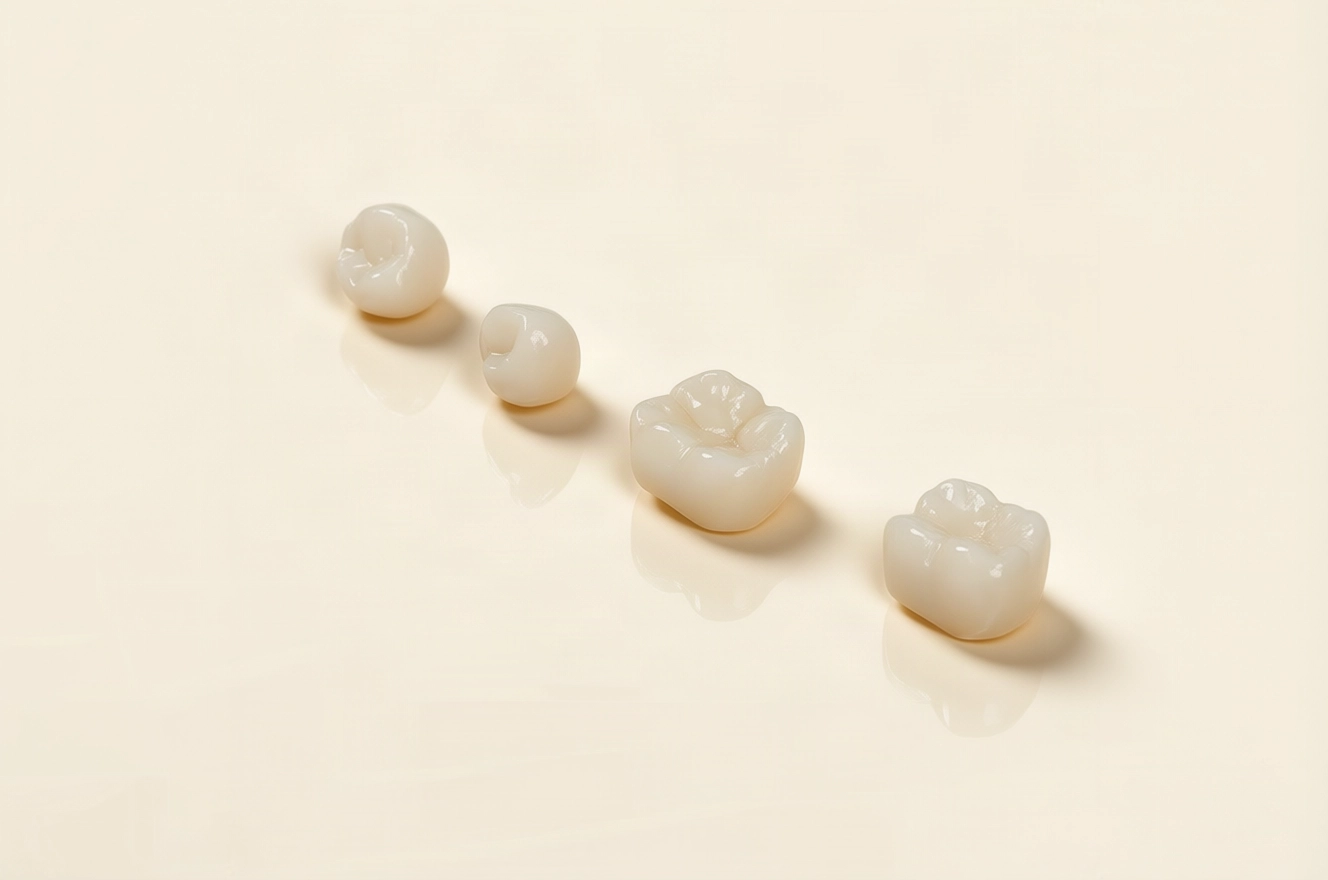
Same-Day or Lab-Made Crown? How I Decide Which One Your Tooth Gets
Quick answer — same-day vs lab-made crowns
A same-day crown and a lab-made crown are the same restoration made in different places, and the published evidence finds no clinically relevant difference in how long they last. The decision is about the tooth, not the technology. Back teeth, single crowns, cracked or broken teeth and anything being done under sedation usually favor same-day milling in the office, because you skip the temporary and the second visit. Front teeth that need a hand-layered shade match, bridges, implant crowns and bites being rebuilt as a set usually go to a dental laboratory, because a ceramist can do things a milling unit cannot. Dr. Nicole M. Berger, DDS does both at South Florida Smile Spa in Pompano Beach and decides case by case.
By Dr. Nicole M. Berger, DDS — South Florida Smile Spa, Pompano Beach
Somewhere along the way, “same-day crown” became a marketing phrase, and like most marketing phrases it started to sound like a verdict. Faster must be better. Or, from the other side of the room: faster must be cutting a corner somewhere. I hear both versions in consultations, usually from patients who have already decided and want me to agree.
I make crowns both ways. I mill them in my office with a CEREC system while the patient waits, and I send them to a dental laboratory where a ceramist builds them by hand over a couple of weeks. Neither route is my default, because the choice between same-day vs lab-made crowns is not really a choice about speed. It is a choice about what a specific tooth, in a specific mouth, needs the finished crown to do. This post is how I make that call, so that when you are sitting in my chair, you understand why your tooth is going one way and not the other.
The honest version: it is the same crown, made in a different place
Let me take the quality question off the table first, because it is the one people worry about most and the one the evidence answers most clearly.
The ceramic that comes out of a chairside milling unit is the same class of material a laboratory uses. Lithium disilicate is lithium disilicate whether it is milled in my office in the afternoon or pressed in a lab across town. A 2025 overview of systematic reviews in the Journal of Dentistry (Laumbacher et al.) pooled the clinical outcome data on lithium disilicate single crowns and found “no clinically relevant differences in survival or complications” between CAD/CAM fabrication and conventional pressed fabrication. Tooth-supported crowns in that body of research survived at 93.8 to 100 percent in the three-to-five-year window, with one life-table analysis putting cumulative survival at 97.9 percent at five years and 96.7 percent at eleven.
So if you have been told a same-day crown is a lesser crown, that is not what the research says. And if you have been told a lab crown is an old-fashioned crown, that is not what the research says either. What the fabrication route changes is not the ceramic. It changes who shapes it, how many visits you make, whether you wear a temporary, and which materials and techniques are available for your particular tooth. Those are real differences, and they are the ones worth deciding on.
What “same-day” actually means in my office
I have written a full explainer on how CEREC same-day crowns work, so I will keep this short. After the tooth is prepared, I scan it with a small intraoral camera instead of taking a tray of impression material. The software builds the crown on screen, where I adjust the contacts and the bite. A milling unit in the office carves the crown from a solid ceramic block, the crown goes through a short firing or crystallization cycle, and I bond it to the tooth. For a single back tooth, the whole thing takes two to three hours and you leave with your final crown, not a temporary.
Two materials cover most of what I mill in the office: lithium disilicate, which is strong and reads well in the mouth for most positions, and zirconia, which is the material I reach for on molars in heavy bites and in patients who grind. Both are monolithic, meaning the crown is one solid piece of ceramic with no weaker layered veneer on top. That matters for durability, and I will come back to it.
What a laboratory adds that a milling unit cannot
A milling unit is extraordinarily precise and completely literal. It makes exactly the crown it is told to make, from one block, in one shade with a gradient baked in. A ceramist is a different kind of instrument.
Natural front teeth are not one color. They are translucent at the edge, more opaque at the neck, with faint bands and flecks and a surface texture that catches light in a particular way. A skilled ceramist builds that up in layers, firing and checking against a photograph of your adjacent teeth, sometimes with you in front of them at a custom shade appointment. I can mill a very good front crown in my office. I cannot mill one that disappears next to a single untouched natural central incisor in a patient who smiles for a living. For that, I send the case out, and I say so plainly.
The lab also does things that are simply outside what a chairside unit is built for: multi-unit bridges, crowns on dental implants with custom abutments, gold crowns for the heaviest grinders, and the sets of crowns in a full-mouth rehabilitation, where the bite is being redesigned across many teeth at once and every crown has to be made against every other one.
Same-day vs lab-made crowns at a glance
| Same-day (milled in office) | Lab-made (built by a ceramist) | |
|---|---|---|
| Visits | One, usually two to three hours | Two, about two weeks apart |
| Temporary crown | None | Yes, worn between visits |
| Materials | Lithium disilicate, zirconia | Layered ceramics, zirconia, pressed ceramic, PFM, gold |
| Shade matching | Single block with built-in gradient — excellent for most teeth | Hand-layered, custom shade appointment — best for a single visible front tooth |
| Typical use | Single crowns and onlays on back teeth, cracked or broken teeth, re-making a lost crown, treatment under sedation | Front teeth needing a precise match, bridges, implant crowns, bites being rebuilt as a set, gold |
| Longevity | No clinically relevant difference in the published evidence; the tooth underneath and your home care decide it | |
When I send your tooth to the lab
A single front tooth next to natural neighbors. This is the clearest case. If the crown has to match one untouched tooth beside it, a layered lab crown with a custom shade is the better answer, and the two-week wait buys something real.
A bridge. Three or more connected units are a laboratory job in my hands. The span has to be made as one piece with the connectors engineered for the load, and that is ceramist work.
A crown on an implant. Implant crowns usually involve a custom abutment and a screw-retained or cemented design that the lab builds against the implant’s exact components. I plan these cases and deliver the final restoration; our periodontist places the implant itself.
A bite being rebuilt. When I am changing how the upper and lower teeth meet, as in a full-mouth case or a worn dentition from years of grinding, the crowns are designed as a set on mounted models, and the lab is where that happens.
A margin I cannot capture cleanly. A scanner needs to see the edge of the preparation. When that edge sits deep under the gum, or the tissue will not stop bleeding long enough for a clean scan, I may take a conventional impression and send it out rather than mill from a compromised scan. The crown is only as good as the edge it is built on.
Gold. For a small number of heavy grinders with a molar at the back, a gold crown is still the kindest thing I can put in the mouth: it wears like a tooth and does not wear the opposing tooth away. Nobody mills that in the office.
When same-day is the better answer, not just the faster one
Most single crowns and onlays on back teeth. Premolars and molars are where same-day milling shines. The shade requirement is modest, the strength requirement is high, and monolithic lithium disilicate or zirconia from the mill is exactly the right material. If you have read my post on how I decide between a crown, a filling and an onlay, you know I try to cover only the part of the tooth that needs covering. The scanner and mill make a partial-coverage onlay as easy to deliver as a full crown, which is one more reason I like having them in the building.
A cracked, broken or lost-crown tooth. When a tooth has cracked or an old crown has come off and cannot be re-cemented, the tooth underneath is exposed and vulnerable. Finishing it in one visit, with the final crown sealed on that afternoon, is not a convenience. It closes the window in which the tooth can fracture further or the nerve can become involved.
Treatment under sedation. This is the one most people have not thought about. A patient who needs IV or oral sedation to get through dental work wants one sedation appointment, not two. With in-office milling, I can prepare the tooth, mill the crown and bond it while the patient is still comfortably sedated, and they wake up finished. For an anxious patient, the second visit to seat a lab crown is often the one that never gets booked.
Anyone for whom a temporary crown is a problem. Which, as it turns out, is a lot of people.
The temporary crown is the real difference
If the ceramic is the same, where does the clinical difference between the two routes actually live? Mostly in the two weeks between the visits.
A temporary crown is a plastic placeholder held on with weak cement, by design, so that I can remove it without damaging the tooth. It does its job most of the time. But temporaries come off. They leak at the edges, and bacteria and saliva reach a freshly cut tooth that has no enamel left to protect it. Teeth under temporaries get sensitive. Patients chew gum, floss them loose, lose them on vacation. A tooth that drifts even slightly while the temporary is off can mean the lab crown no longer fits when it arrives, and we start over.
None of that is catastrophic, and for a front tooth where the final result justifies it, I accept the temporary phase gladly. But when a tooth does not need what the lab offers, skipping the temporary removes an entire category of small problems from the process. That, more than any argument about materials, is why most single back-tooth crowns in my practice are milled the same day.
Does a same-day crown last as long?
The longest-running data on chairside crowns comes from a German group that followed monolithic lithium disilicate crowns milled in the office. At ten years they reported 83.5 percent survival (Rauch et al., 2018), and the same cohort at fifteen years, by then a small group, showed 80.1 percent survival (Rauch et al., 2023). Those are honest numbers for crowns that were among the first of their kind, and they sit comfortably alongside what has historically been reported for lab-made crowns over the same horizons.
What I find most useful in that research is the reason crowns failed. In the fifteen-year data, five of the six failures were biological: decay at the crown margin, a root fracture, an infection at the root tip, a tooth that broke. Only one was the crown itself, and that was from trauma. In other words, same-day crowns mostly do not fail. The teeth under them do, for the same reasons any tooth fails. The fabrication route you choose today matters far less to the next fifteen years than what happens at the margin of that crown every night before bed.
Why a crown’s edge is a whole-health matter
That margin, the line where ceramic meets tooth, is where a crown lives or dies, and it is affected by everything else going on in your body. A dry mouth from medications or diabetes gives decay a head start at that line. Acid reflux softens the tooth structure just below it. Nighttime grinding loads the crown in ways it was never designed for. Gum disease moves the gumline down and exposes root surface beneath the margin that was never meant to be in the open.
The American Dental Association’s MouthHealthy page on crowns puts the purpose simply: “A crown can help strengthen a tooth with a large filling when there isn’t enough tooth remaining to hold the filling.” A crown is a structural rescue of a tooth that has already lost a fight, and whether you keep it for twenty years depends on not losing the next one. That is why I ask about your medications, your sleep, your reflux and your gums before I ask which fabrication route you would prefer. The question of same-day vs lab-made crowns is downstream of all of it.
A representative case: two crowns, two roads, one mouth
The following is a composite scenario, a blend of details from many patients. It is not a real individual and not a testimonial.
A man in his fifties came in with two problems he had been managing separately for a year. A lower molar had a crack through an old silver filling and hurt when he bit down on anything hard. And an upper front tooth, root-canal-treated decades ago, had darkened and chipped at the corner, and he had stopped smiling with his top lip up.
The molar was straightforward. I prepared it, scanned it, milled a zirconia crown and bonded it that afternoon. He ate dinner on it. No temporary, no second visit, and the crack was sealed the same day it was diagnosed instead of two weeks later.
The front tooth was the opposite decision. It sat between two natural teeth with the slightly warm, slightly translucent character teeth get in your fifties, and he wanted it to vanish. I prepared it, took photographs with shade tabs, and sent the case to a ceramist with a request for a layered crown with a lightly opaque core to mask the darkened root. He wore a temporary for just under three weeks and came back for one try-in before we cemented it. Nobody can find it, which was the goal.
Same mouth, same month, two completely different fabrication routes. Neither was better. Each was right for its tooth.
Where sedation fits
Because sedation is so much of what we do, it shapes this decision more in my practice than it might elsewhere. For a sedated patient who needs one or two back-tooth crowns, same-day milling means the entire job happens inside a single sedation appointment. For a sedated patient who needs lab work, I arrange it so that the preparation, impressions and temporaries all happen under sedation, and the final seating visit is the short, gentle one, often manageable with nitrous or nothing at all. Either way, the goal is that nobody has to be brave twice.
If you are planning sedation, read what I need to know about your medications before a sedation appointment first. It changes how I plan the day.
How to ask the question at your consultation
Do not ask “do you do same-day crowns?” Almost every practice with a scanner will say yes. Ask instead: “Which teeth do you mill in the office, which do you send to a lab, and why would mine go one way rather than the other?” A dentist who makes crowns both ways will have an answer that is about your tooth. A dentist who only has one route will, understandably, recommend that route. Both are fine. You just want to know which conversation you are in.
And if your crown has already failed, or a tooth has cracked and you are reading this at the kitchen table, the first step is not choosing a fabrication route. It is getting the tooth looked at this week. The route follows from the exam.
Frequently asked questions: same-day vs lab-made crowns
Are same-day crowns as good as lab-made crowns?
For most teeth, yes. The ceramics milled in the office are the same class of material a laboratory uses, and a 2025 overview of systematic reviews found no clinically relevant difference in survival or complications between CAD/CAM and conventionally fabricated lithium disilicate crowns. The real differences are practical: a same-day crown needs one visit and no temporary, while a lab crown offers hand-layered shade matching and designs a milling unit cannot make, such as bridges and implant crowns.
How long does a same-day crown appointment take?
Plan on two to three hours for a single tooth. That covers numbing, preparing the tooth, scanning it, designing the crown on screen, milling it from a ceramic block, a short firing or crystallization cycle, and bonding it in place. You leave with the final crown and can eat normally once the numbness wears off.
Why would a dentist send a crown to a lab instead of making it in the office?
Because some teeth need what only a ceramist can do. A single front tooth that has to match natural neighbors benefits from hand-layered ceramic and a custom shade appointment. Bridges, crowns on dental implants, gold crowns and sets of crowns in a full-mouth rehabilitation are all built in a laboratory. A dentist may also choose a conventional impression and lab fabrication when a preparation margin sits too deep under the gum to scan cleanly.
Do same-day crowns last as long as traditional crowns?
The published data says there is no clinically relevant difference. The longest-running study of chairside lithium disilicate crowns reported 83.5 percent survival at ten years and 80.1 percent at fifteen, and most failures were the tooth underneath, not the crown: decay at the margin, root fracture or infection. How long any crown lasts depends mostly on the tooth it sits on and how well the margin is kept clean, not on where the crown was made.
Can a front tooth get a same-day crown?
Often, yes, particularly when several front teeth are being treated together or the neighboring teeth are already crowned, because the shade only has to match itself. When a single front crown must disappear next to one untouched natural tooth, a laboratory crown with a custom shade is usually the better choice, and the two-week wait is worth it.
Do I need a temporary crown with a same-day crown?
No. The final crown is milled and bonded in the same appointment, so there is no temporary phase. That removes the most common small problems of crown treatment: a temporary coming off, leaking at the edges, causing sensitivity, or the tooth shifting slightly before the final crown arrives.
Can I get a same-day crown if my old crown fell off?
Frequently, yes. If the crown can be re-cemented, that is the first option. If it cannot, because it is cracked, the tooth under it has decayed, or it has been off too long and the fit has changed, a new crown can usually be scanned, milled and bonded in one visit, as long as the tooth has enough sound structure left. Keep the old crown and bring it with you; it tells me a great deal about why it came off.
Let the tooth decide
If you have been told you need a crown and you want to know which route is right for your tooth, that is a twenty-minute conversation with a scan and an X-ray in front of us. We make crowns both ways, and we will tell you which one your tooth needs and why.
South Florida Smile Spa · 572 E McNab Rd, Suite 102, Pompano Beach, FL 33060 · (954) 785-1100
Dr. Nicole M. Berger, DDS practices at South Florida Smile Spa, 572 E McNab Rd, Suite 102, Pompano Beach, FL 33060, and welcomes patients from Pompano Beach, Fort Lauderdale, Deerfield Beach, Lighthouse Point and Coconut Creek.
This article is for general education and is not a substitute for individual examination, diagnosis, or treatment planning. Which type of crown is right for a tooth can only be decided after an in-person examination.

Dr. Nicole M. Berger, DDS
Dr. Berger has cared for patients in Pompano Beach for over two decades at South Florida Smile Spa, with a focus on cosmetic dentistry, implants and reconstruction, and sedation options for anxious patients.