

Sleep Apnea and Your Teeth: What Your Dentist Sees Before Your Doctor Does
Quick answer
A dentist cannot diagnose sleep apnea, but a dental exam is often where the first signs of it show up. The pattern I look for is a combination, not a single finding: flattened or chipped teeth from nighttime grinding, a tongue with scalloped edges, a crowded airway at the back of the mouth, a small or set-back lower jaw, gums inflamed from mouth breathing, and dry mouth on waking. When several of those appear in someone who snores, wakes unrefreshed, or has high blood pressure, I ask about a sleep evaluation. Diagnosis comes from a sleep study read by a physician; treatment may include CPAP or a custom oral appliance that a dentist fits.
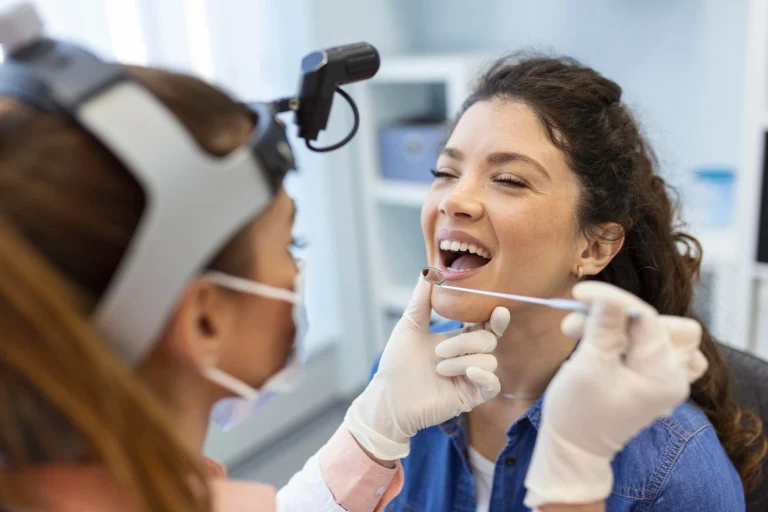
Nobody books a dental appointment because they think they have sleep apnea. They come in because a molar chipped on a piece of toast, or their gums bleed, or their partner made them get a night guard because the grinding sounds like gravel. Then I look in, and sometimes the mouth tells a story about the night that the patient has never heard.
That is the odd position dentistry is in with sleep apnea. We are not the people who diagnose it, and we should never pretend to be. But we see most adults twice a year, we look at the airway every time we ask you to open wide, and many of the physical signs of a struggling airway are written on the teeth, the tongue, and the gums long before anyone orders a sleep study.
So this post is about what I actually see, what each sign does and does not mean, the questions I ask when the pattern lines up, and how the handoff to a physician works. It is also about the limits of all of it, because a dentist who overcalls sleep apnea does as much harm as one who never mentions it.
What sleep apnea is, in plain terms
The American Dental Association’s consumer site, MouthHealthy, puts it simply: “Sleep apnea is a common and serious sleeping disorder that happens when your regular breathing is interrupted during sleep.” In obstructive sleep apnea — the common form, and the one dentistry is involved with — the interruption is mechanical. When you fall asleep the muscles holding your throat open relax, the soft tissue and tongue fall back, and the airway narrows or closes. Oxygen drops, the brain registers the problem, you surface just far enough out of deep sleep to tighten the muscles and breathe, and then it happens again. Dozens of times an hour, in moderate and severe cases, without the person ever fully waking.
Two things follow from that mechanism, and both matter for what I see in the chair. First, the anatomy of the mouth and jaw is part of the airway — the size of the tongue, the position of the lower jaw, the width of the palate. The National Heart, Lung, and Blood Institute lists a large tongue among the risk features and explains why: “These features can narrow your upper airway or make it more likely for your tongue to block your airway while you sleep.” Second, the repeated arousals are not silent. The body clenches, grinds, breathes through the mouth, and in many people pushes stomach acid upward — and every one of those leaves marks.
One clarification before going further, because it is the most common misunderstanding I hear. Snoring is not the same thing. MouthHealthy is careful about this: “Snoring is common among patients with sleep apnea but not all snorers have sleep apnea.” Plenty of people snore loudly and breathe perfectly well; some people with significant apnea barely snore at all. Snoring is a reason to ask questions, not an answer.
Why most people with sleep apnea do not know they have it
The scale of this is larger than most patients expect. A 2019 analysis in The Lancet Respiratory Medicine estimated that 936 million adults between 30 and 69 have mild to severe obstructive sleep apnea worldwide, and 425 million have moderate to severe disease. In the United States, an economic analysis commissioned by the American Academy of Sleep Medicine estimated that about 12% of adults have it — “with nearly 80% of the population undiagnosed.”
That last number is a commissioned estimate rather than a peer-reviewed study, and I would not hang a clinical decision on its precision. But the direction is not in dispute: most people with sleep apnea have never been tested. The reason is built into the condition. The events happen while you are unconscious. What you notice during the day — tiredness, a dull morning headache, trouble concentrating, irritability — is easy to blame on work, age, stress, or a bad mattress. The person most likely to notice the actual breathing pauses is whoever sleeps next to you, and plenty of people sleep alone.
Which is exactly why the ADA’s policy on dentistry and sleep-related breathing disorders says that “Dentists are encouraged to screen patients for SRBD as part of a comprehensive medical and dental history.” Screening is the right word. It means noticing, asking, and referring — not diagnosing.
The signs of sleep apnea I can see in your mouth
None of the findings below proves anything on its own. Each has other explanations, and I will say what those are. What makes me ask about sleep is when several of them appear in the same mouth.
Worn, flattened, or chipped teeth. Grinding during sleep flattens the biting edges of the front teeth, wears facets into the canines, and leaves fine cracks and chips in the back teeth. The connection to sleep apnea is real but not simple. A 2025 systematic review in the Journal of Clinical Medicine found that “The prevalence of SB was consistently higher in individuals with OSA compared to the general population” — SB being sleep bruxism — while noting that inconsistent diagnostic criteria limited how strong a conclusion could be drawn. The current understanding is that grinding is often part of the brief arousal that reopens a collapsing airway: the jaw moves, muscle tone comes back, breathing resumes. I went into the mechanics in how bruxism quietly wrecks your teeth. Plenty of people grind for other reasons — stress, certain medications, reflux — so wear is a question, not a verdict.
A scalloped tongue. When the tongue is large relative to the space inside the lower jaw, it presses against the teeth and the sides take on a wavy, indented edge, like a pie crust. It is easy to see and patients rarely know they have it. The evidence here needs careful reading. A 2025 study of 160 patients who had sleep studies, published in Frontiers in Sleep, found that a scalloped tongue on its own was not significantly associated with a sleep apnea diagnosis — but in combination with a neck circumference of 40 centimeters or more, it was associated with roughly four times the odds of severe sleep apnea. The authors concluded that it “may serve as an additional useful clinical sign of severe OSA.” That is how I use it: as one piece, weighted more heavily when other pieces are present.
A crowded view of the back of the throat. When you open wide and I cannot see much past the tongue — no clear view of the soft palate, the uvula, or the tonsils — the airway behind it is often narrow too. Large tonsils add to the crowding. Physicians use a formal version of this observation as part of airway assessment, and it is one of the reasons I pay attention to the airway before any sedation appointment.
A small or set-back lower jaw, and a narrow, high palate. NHLBI notes that facial and skull structure helps “determine the size and shape of your skull, face, and upper airway.” A lower jaw that sits back relative to the upper jaw leaves the tongue less room and lets it fall backward more easily when you lie down. A narrow, vaulted palate often travels with a narrow nasal airway above it. Crowded lower teeth can be a clue to the same small-jaw pattern.
Signs of mouth breathing: dryness and a particular kind of gum inflammation. If the nose is blocked or the airway is fighting for air, many people breathe through the mouth all night. NHLBI lists dry mouth among the symptoms of sleep apnea, and the patient version is waking with a parched mouth and a glass of water already on the nightstand. In the mouth, chronic mouth breathing tends to leave the gums along the upper front teeth swollen, shiny, and red — the tissue the airflow dries out — even in someone who brushes well. Dryness also accelerates decay, which I covered in why dry mouth is a cavity accelerator.
Acid erosion. Nighttime reflux and sleep apnea commonly travel together; the pressure changes of struggling to breathe against a closed airway are thought to pull stomach contents upward. Reflux leaves a recognizable pattern of erosion — smooth, glassy, thinning enamel, especially on the inside surfaces of the upper teeth and the chewing surfaces of the molars. If you see yourself in that description, read what acid reflux damage looks like on teeth, because the management is different from grinding wear even when both are present.
Jaw soreness and morning headaches. These are things you tell me rather than things I see, but they belong on the list. Waking with a tight jaw or a dull headache at the temples can come from overnight clenching, from oxygen drops, or from both. They overlap heavily with TMJ and jaw pain, which is one more reason the sleep question has to be asked before anyone settles on a single explanation.
Why one sign means very little and a pattern means a lot
Every finding above has an innocent explanation. A scalloped tongue can come from a clenching habit during the day. Wear can be decades of an edge-to-edge bite. Inflamed gums are usually just plaque. If I mentioned sleep apnea every time I saw one of these, I would frighten a lot of healthy people and lose credibility with the ones who needed to hear it.
What changes the picture is accumulation. Heavy wear plus a scalloped tongue plus a crowded airway in a patient who also snores, is on two blood pressure medications, and falls asleep in my chair during a cleaning — that is a pattern. At that point the useful thing is not to keep quiet out of politeness. It is to ask a few direct questions and, if the answers line up, say the words “sleep evaluation” out loud.
The questions I ask when the pattern lines up
The ADA’s clinical resource on obstructive sleep apnea notes that health history-taking “can be supplemented with use of one or more of the OSA-specific screening questionnaires,” and the one most offices use is STOP-Bang. You do not need to memorize it, but it is useful to know what it covers, because these are the questions worth answering honestly:
- Snoring — loud enough to be heard through a closed door, or enough that a partner has moved rooms.
- Tiredness — falling asleep reading, watching television, or as a passenger, even after what should have been a full night.
- Observed pauses — has anyone seen you stop breathing, choke, or gasp during sleep?
- Pressure — are you being treated for high blood pressure?
- BMI, age, neck size, and sex — higher body weight, being over 50, a larger neck, and being male each raise the odds.
I add a few of my own, because they come up so often in a dental context: Do you wake with a dry mouth? Do you get up to urinate several times a night? Do you wake with headaches or a sore jaw? Has a night guard ever made you sleep worse instead of better? A questionnaire does not diagnose anything. It sorts people into lower and higher likelihood, and the higher-likelihood group is who I refer.
Sleep apnea and gum disease: a link worth knowing about
There is a second connection that gets less attention than grinding. A 2024 systematic review and meta-analysis in Dentistry Journal found that people with obstructive sleep apnea had about two and a half times the odds of periodontitis compared with people without it. The authors were appropriately cautious — “The results suggest a potential association between OSA and periodontitis” — and called for more research into why.
The plausible explanations overlap: mouth breathing dries the tissue and changes the bacteria that live on it; repeated oxygen drops drive body-wide inflammation; and the two conditions share risk factors such as diabetes and higher body weight. None of that proves one causes the other. But in practice it means that a patient whose gum disease keeps flaring despite good home care is one more person I ask about sleep, and a patient with known sleep apnea is one I watch more closely at every professional cleaning.
Why this matters far beyond your teeth
If sleep apnea only took some enamel, I would not write about it at this length. The reason dentists are asked to screen for it is what it does to the rest of the body. MouthHealthy states it directly: “If left untreated, sleep apnea can result in a number of health problems including” high blood pressure, stroke, heart failure, irregular heartbeat, heart attack, diabetes, and depression. NHLBI’s summary is shorter and just as blunt: “Untreated sleep apnea increases the risk for stroke, heart attack, and other serious problems,” and its research “found that sleep apnea may raise the risk for high blood pressure, diabetes, heart disease, and stroke.”
Think about what that means in a dental chair in Pompano Beach. The patient whose blood pressure will not come down despite two medications, the patient whose blood sugar control keeps slipping, the patient who has quietly started dozing at red lights — some fraction of them have an airway problem nobody has looked for, and their teeth may be the first place it is visible. That is the whole-health thread I keep coming back to on this site, from gum disease and heart disease to oral health and overall well-being: the mouth is not a separate system, and what I see in it is often information your physician would want.
There is also a safety reason close to home. Sleep apnea changes how the body handles sedation, which is why I ask about it before any sedated appointment and why I wrote about planning sedation when you have sleep apnea, a heart condition, or diabetes. An undiagnosed airway problem is exactly the kind of thing I want to know about before the day of treatment, not during it.
A composite case: the night guard that kept cracking
The following scenario is a composite, assembled from several patients to illustrate a common clinical pattern. It does not describe any individual patient, and no real patient’s history, words, or identifying details appear in it.
A man in his early fifties, a long-time patient, comes in with his second cracked night guard in two years and a chipped lower front tooth. His wear has visibly progressed since his last set of photographs. He brushes and flosses well, but his upper front gums are puffy and red, and his tongue has a clear scalloped edge. When he opens wide, I can barely see past his tongue.
I ask the questions. He snores — his wife has been sleeping in the guest room for a year. He takes two medications for blood pressure that his physician has been adjusting for months. He wakes most mornings with a dry mouth and a dull headache and assumed both were from the grinding. No one has ever suggested a sleep study, and he had never connected any of it.
I do not tell him he has sleep apnea. I tell him that the combination of findings is one I take seriously, explain why, and write to his primary care physician describing what I see and asking whether a sleep evaluation makes sense. A home sleep test, read by a sleep physician, shows moderate obstructive sleep apnea. His physician starts treatment. Over the following months his blood pressure becomes easier to control, and the new wear on his teeth slows to almost nothing — something no thicker night guard had managed.
The point of the composite is not the diagnosis. It is that two cracked night guards were the dental symptom of a breathing problem, and a stronger guard would have treated the symptom while the cause kept going.
What I will not do
I will not tell you that you have sleep apnea. The ADA is unambiguous: “Diagnosis of OSA is made by a physician or trained sleep specialist after comprehensive assessment of the patient.” Its policy on dentistry’s role says the same thing in practical terms — “If risk for SRBD is determined, these patients should be referred, as needed, to the appropriate physicians for proper diagnosis.” My job ends at noticing, documenting, and referring, and I take that boundary seriously.
I will not make an anti-snoring device for someone who has not been evaluated. A mouthpiece can quiet snoring while the apnea underneath carries on, which makes everyone in the house feel better and leaves the actual risk untouched. Snoring is the symptom that gets people in the door; it is not what I am treating.
And I will not keep making heavier night guards for a heavy grinder without asking about sleep. A guard protects teeth from grinding force. It does nothing for the airway, and some guard designs can let the lower jaw settle backward during sleep, which is the wrong direction for an airway that is already struggling. If the pattern points at sleep, the conversation about the airway comes before the next night guard, not after.
From suspicion to diagnosis: how testing works
For most adults the next step after a positive screen is a sleep study, and for many people that no longer means a night in a hospital sleep lab. A home sleep test is a small device worn for a night or two in your own bed that records breathing, oxygen levels, and heart rate. The recording is then read by a sleep physician, who makes the diagnosis and decides on treatment. Some patients — particularly those with significant heart or lung disease, or symptoms that suggest something other than obstructive apnea — still need an in-lab study, and that decision belongs to the physician.
For patients who would rather start here, our office can arrange a home sleep test through a third-party sleep testing company, with the results read by a sleep physician. Either way, the order of operations is the same: screening, then a test, then a physician’s diagnosis, then treatment. Skipping steps is how people end up with the wrong device for the wrong problem.
Where a dentist fits into treatment
CPAP — a machine that keeps the airway open with gentle air pressure through a mask — is the standard treatment and the most effective one when people use it. The difficulty is that a meaningful number of people cannot tolerate it or stop using it. That is where dentistry comes in. The American Academy of Sleep Medicine and the American Academy of Dental Sleep Medicine’s joint guideline states: “We recommend that sleep physicians consider prescription of oral appliances, rather than no treatment, for adult patients with obstructive sleep apnea who are intolerant of CPAP therapy or prefer alternate therapy.”
An oral appliance for sleep apnea is not a night guard. It is a custom, adjustable two-piece device that holds the lower jaw slightly forward during sleep, which pulls the tongue forward and keeps the airway from collapsing. The same guideline recommends that “a qualified dentist use a custom, titratable appliance over non-custom oral devices,” and the ADA’s position is that oral appliance therapy is appropriate for mild and moderate sleep apnea, and for severe sleep apnea when CPAP is not tolerated. MouthHealthy’s summary is suitably measured: “Research shows that oral appliances can successfully prevent sleep apnea in some mild to moderate cases.”
The appliance is prescribed by the physician and fitted, adjusted, and monitored by the dentist, with a follow-up test to confirm it is actually working. I am keeping this section short on purpose, because how the appliance compares with CPAP, what fitting involves, and what it will and will not do is covered in detail on our sleep apnea and snoring treatment page. The point here is narrower: if your teeth are what raised the question, your dentist may also be part of the answer.
Protecting your teeth while the airway question gets answered
Getting from a screening to a diagnosis to working treatment can take weeks. In the meantime the teeth still need looking after, and the priorities depend on which signs brought us here.
- For wear and chipping, I document it with photographs so we can measure whether it slows once breathing is treated, and I hold off on large cosmetic or restorative work on worn teeth until the forces causing the wear are under control.
- For dryness, prescription-strength fluoride, water at the bedside, and a humidifier help protect against the fast decay that a dry mouth invites.
- For inflamed gums, a shorter cleaning interval and careful attention to the upper front tissue that mouth breathing dries out.
- For erosion, a conversation with your physician about reflux, and not brushing for a while after a reflux episode, when softened enamel is most vulnerable.
Once treatment is in place, I re-examine the same teeth and tissues. One of the more satisfying moments in this work is seeing wear that had been progressing steadily simply stop.
When to bring this up at your next visit — or sooner
Mention it at your next appointment if any of these apply. If several do, it is worth calling rather than waiting:
- Someone has seen you stop breathing, choke, or gasp in your sleep.
- You snore loudly and wake unrefreshed most mornings, however long you slept.
- You fall asleep without meaning to — reading, watching television, or worse, driving.
- You have high blood pressure that has been hard to control.
- You have cracked a night guard, or a dentist has told you your wear is getting worse.
- You wake with a dry mouth, a sore jaw, or a headache most days.
- You have been prescribed CPAP and stopped using it. That is not a failure — it is a reason to talk about alternatives.
If you are drowsy enough that you have nodded off at the wheel, do not wait for a dental appointment. Speak to your physician now.
Our office hours are Monday 8:30 AM to 12:30 PM, Tuesday 8:00 AM to 5:00 PM, Wednesday 8:30 AM to 12:30 PM, Thursday 9:30 AM to 6:30 PM, and Friday 8:00 AM to 5:00 PM. We are closed Saturday and Sunday.
Frequently asked questions about sleep apnea and your teeth
Can a dentist tell if you have sleep apnea?
A dentist can see signs that raise the possibility, but cannot diagnose it. The findings that make me ask about sleep include worn or chipped teeth from nighttime grinding, a scalloped tongue, a crowded view of the back of the throat, a small or set-back lower jaw, gum inflammation from mouth breathing, and dry mouth. When several of those appear together in someone who snores or wakes unrefreshed, I recommend a sleep evaluation. The diagnosis itself is made by a physician or sleep specialist, usually after a sleep study.
What are the dental signs of sleep apnea?
The most common are tooth wear and chipping from sleep bruxism, a tongue with wavy indented edges, a narrow airway at the back of the mouth, a lower jaw that sits back relative to the upper jaw, a narrow high palate, red and swollen gums along the upper front teeth from mouth breathing, dry mouth on waking, and acid erosion from nighttime reflux. Each has other possible causes, so no single sign means sleep apnea. It is the combination, together with symptoms like snoring and daytime tiredness, that matters.
Does teeth grinding mean I have sleep apnea?
Not necessarily. Sleep bruxism is more common in people with obstructive sleep apnea than in the general population, and grinding often happens during the brief arousals that reopen a collapsing airway. But many people grind because of stress, medications, or reflux and breathe perfectly well. If you grind heavily and also snore, wake tired, or have high blood pressure, it is worth asking about a sleep evaluation before relying on a night guard alone.
What does a scalloped tongue mean?
A scalloped tongue has wavy indentations along its sides where it presses against the teeth, usually because the tongue is large relative to the space inside the lower jaw. It can also come from daytime clenching or tongue pressing. Research suggests it is not reliable on its own as a sign of sleep apnea, but in combination with a larger neck size it has been associated with severe sleep apnea, so I treat it as one piece of a larger picture.
Can an oral appliance treat sleep apnea instead of CPAP?
For some people, yes. A custom, adjustable oral appliance holds the lower jaw slightly forward during sleep to keep the airway open. Sleep medicine guidelines support it for adults who cannot tolerate CPAP or prefer an alternative, and the ADA considers it appropriate for mild and moderate sleep apnea and for severe sleep apnea when CPAP is not tolerated. It is prescribed by a physician, fitted and adjusted by a dentist, and confirmed with a follow-up sleep test. CPAP remains the standard treatment, especially for severe disease.
Is snoring the same as sleep apnea?
No. Snoring is common in people with sleep apnea, but many people snore without having it, and some people with sleep apnea snore very little. What separates them is whether breathing is actually interrupted during sleep, which only a sleep study can measure. That is also why I will not make an anti-snoring device for someone who has not been evaluated: quieting the snoring can hide apnea that is still happening.
Is sleep apnea linked to gum disease?
Research suggests an association. A 2024 meta-analysis found that people with obstructive sleep apnea had about two and a half times the odds of periodontitis, though the authors described it as a potential association that needs more study. Mouth breathing, body-wide inflammation from repeated oxygen drops, and shared risk factors such as diabetes are all plausible explanations. In practice, gum disease that keeps flaring despite good home care is one more reason I ask about sleep.
Your first step is a conversation
If some of this sounded familiar, the most useful thing you can do is mention it at your next exam — the snoring, the tiredness, the cracked guard, the dry mouth — and let me look at your teeth and airway with that question in mind. It takes a few minutes. Most of the time the answer is reassuring. When it is not, finding out from a dentist who noticed is a much better story than finding out years later.
If you already have a diagnosis and are struggling with CPAP, bring that up too. There may be another way to treat the same airway.
— Dr. Nicole M. Berger, DDS · South Florida Smile Spa · 572 E McNab Rd, Suite 102, Pompano Beach, FL 33060 · (954) 785-1100
This article is for general information and is not a substitute for an examination, a sleep study, or medical advice from your physician. Sleep apnea is diagnosed by a physician or sleep specialist.
Sources: American Dental Association, MouthHealthy, “Sleep Apnea and Snoring”; American Dental Association Oral Health Topics, “Sleep Apnea (Obstructive)”; American Dental Association, “The Role of Dentistry in the Treatment of Sleep Related Breathing Disorders” (adopted 2017); National Heart, Lung, and Blood Institute, “Sleep Apnea” (What Is Sleep Apnea?, Causes and Risk Factors, Symptoms, Treatment); Ramar K, Dort LC, Katz SG, et al. “Clinical Practice Guideline for the Treatment of Obstructive Sleep Apnea and Snoring with Oral Appliance Therapy: An Update for 2015.” Journal of Clinical Sleep Medicine. 2015;11(7):773–827; Benjafield AV, et al. “Estimation of the global prevalence and burden of obstructive sleep apnoea: a literature-based analysis.” The Lancet Respiratory Medicine. 2019;7(8):687–698; Frost & Sullivan for the American Academy of Sleep Medicine, “Hidden Health Crisis Costing America Billions” (2016); Doblado NG, et al. “Relationship Between Bruxism and Obstructive Sleep Apnea: A Systematic Review of the Literature.” Journal of Clinical Medicine. 2025;14(14):5013; Guimarães FN, et al. “Scalloped tongue: an additional, accessible and useful tool to detect severe obstructive sleep apnea?” Frontiers in Sleep. 2025;4:1652532; Portelli M, et al. “Correlations between Obstructive Sleep Apnea Syndrome and Periodontitis: A Systematic Review and Meta-Analysis.” Dentistry Journal. 2024;12(8):236.

Dr. Nicole M. Berger, DDS
Dr. Berger has cared for patients in Pompano Beach for over two decades at South Florida Smile Spa, with a focus on cosmetic dentistry, implants and reconstruction, and sedation options for anxious patients.