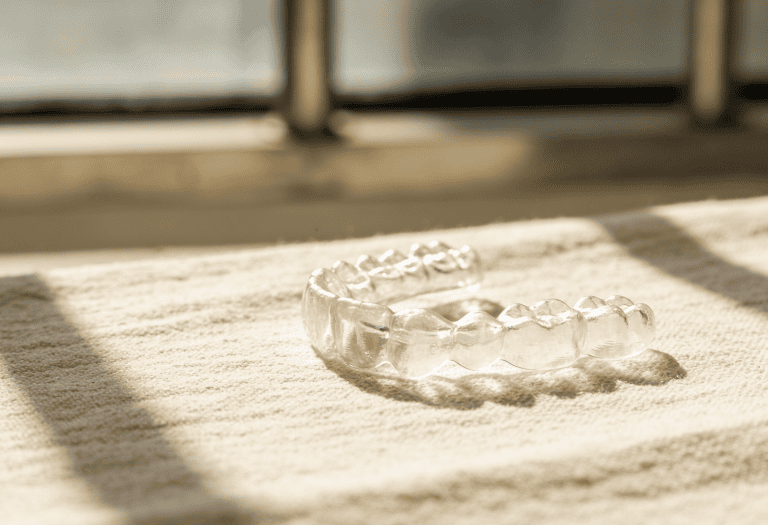


Invisalign for Adults in Pompano Beach: Straightening Teeth Without Anyone Noticing
By Dr. Nicole M. Berger, DDS — South Florida Smile Spa, Pompano Beach
Quick answer
No, it is not too late for Invisalign as an adult. Teeth move in response to controlled pressure at any age, and roughly one in three orthodontic patients today is an adult. What decides candidacy is not your birthday but the health of your gums and bone, the restorations you already have, and whether you can wear aligners 20 to 22 hours a day.
Mild cases typically take 6 to 12 months, moderate cases 12 to 18, complex cases 18 to 24 or more — followed by retainers indefinitely.
A patient asked me last month whether it was embarrassing to want straighter teeth at 54. I have been asked some version of that question for twenty years in this office, and it still lands the same way: the assumption underneath it is that orthodontics is a teenage rite of passage with an expiration date.
It is not. The biology that moves a tooth at 14 is the same biology that moves it at 64. What changes with age is not whether treatment works — it is that adults arrive with a dental history. Old fillings, a crown or two, some gum recession, a bite that has been wearing unevenly for decades. Those are planning questions, not disqualifications, and answering them well is the difference between an adult Invisalign case that finishes beautifully and one that stalls.
This post is the honest version of the conversation I have in the consultation chair: who is a good candidate, what I check before I say yes, the cases where I say no, what the timeline really looks like, and why I consider straightening teeth a health decision rather than a cosmetic one.
Am I too old for Invisalign? The honest answer
There is no upper age limit for clear aligner therapy. Teeth sit in bone that is constantly remodeling — cells break bone down on one side of the root and rebuild it on the other in response to gentle, sustained pressure. That process does not switch off in adulthood. The American Association of Orthodontists reports that roughly one in three orthodontic patients today is an adult, and in my own practice the fastest-growing group is patients in their 50s and 60s who finally have the time and the motivation.
What does change is the condition of the foundation. A 16-year-old almost always has healthy gums and full bone support. An adult may not. Moving teeth through inflamed or receded tissue can accelerate bone loss, which is why the first thing I evaluate is never the alignment — it is the periodontal health underneath it.
Why crooked teeth are a health problem, not just a photo problem
Most adults frame this as a confidence decision, and confidence is a perfectly good reason. But I want to be direct about the clinical side, because it is the part almost nobody explains.
Crowding isn’t only a cosmetic issue. It’s a place plaque hides where a toothbrush can’t follow.
Dr. Nicole M. Berger, DDS
Overlapped teeth create surfaces that no amount of careful brushing will fully reach. Plaque that sits undisturbed at the gumline matures into a bacterial film that inflames the gums — gingivitis — and, over years, into periodontitis with measurable bone loss. The ADA’s patient resource at MouthHealthy.org describes exactly this progression, and a large body of research has documented associations between periodontal disease and conditions including cardiovascular disease and diabetes. Those are associations rather than proven causation, but the direction of the evidence is consistent, and it is why I treat gum health as a whole-body concern rather than a dental one.
Bite problems matter too. Edge-to-edge and deep bites wear enamel in patterns I can practically date. Crowded lower incisors chip. A crossbite loads one side of the jaw more than the other, which shows up years later as jaw pain and TMJ symptoms or as a molar that cracks under a force it was never meant to carry. Malocclusion is a functional problem that happens to have an aesthetic component — and it does not become less functional at 54.
So when an adult asks me whether straightening is worth it, my answer is that a well-aligned bite is easier to keep clean, wears more evenly, and gives every restoration you already have a better chance of lasting. The straighter smile is the part you see. The rest is the part I care about.
What I check before I say yes
An adult Invisalign consultation at South Florida Smile Spa is mostly examination and conversation. Before I recommend aligners, I look at six things:
- Gum health. I probe the pockets around every tooth and look for bleeding, recession and inflammation. Active gum disease has to be treated and stable before any tooth moves. Many of those cases are handled in-house with deep cleaning; more advanced cases involve our periodontal team.
- Bone support. Digital X-rays — and cone beam 3D imaging when the case warrants it — show me how much bone surrounds each root. Bone that has already receded changes how far and how fast I can move a tooth safely.
- Existing restorations. Crowns, large fillings, bridges and implants all affect the plan. An implant cannot move at all, so it becomes a fixed anchor the rest of the plan works around. A crown can move but may need its attachment placed differently. None of this rules you out; it changes the engineering.
- Bite and wear. I look for the flat, polished facets that tell me a patient grinds at night, because bruxism affects both the aligner material and how I sequence the movements. Sometimes we address the grinding first.
- Active decay. Any cavities are restored before aligners are made, because the tray fits the tooth’s current shape and a filling placed mid-treatment can throw off the fit.
- Real-life compliance. Aligners only work when they are in your mouth. I ask honestly about work travel, meetings that run through lunch, and whether 20 to 22 hours a day is realistic. For most adults it is — but it is better to know now.
Then we take a digital scan — no impression material — and I can show you a simulation of the projected result before you commit to anything.
The cases where I don’t recommend aligners
I do not believe in overpromising, so here is where I say no or send a patient elsewhere:
- Skeletal discrepancies. When the jaws themselves are mismatched — a true underbite from jaw position rather than tooth position — aligners alone cannot fix it. Those cases belong with an orthodontist and sometimes an oral surgeon, and I refer them.
- Severely impacted or rotated teeth. Some movements are simply more predictable with fixed braces. I would rather tell you that than start a case I expect to struggle with.
- Untreated periodontal disease. Until the inflammation is controlled, moving teeth risks accelerating bone loss. We treat first, then reassess.
- A patient who tells me the hours are not realistic. Aligners worn twelve hours a day do not work slowly; they do not work at all, and the teeth drift between wear periods. If that is where life is right now, we wait.
How adult Invisalign treatment actually works
Once you are a candidate, the process is straightforward:
- Scan and plan. The digital scan is used to design every stage of movement. I review and adjust that plan before anything is manufactured.
- Attachments and refinements. Small tooth-colored buttons are bonded to certain teeth to give the aligner something to push against. Occasionally I will polish a fraction of a millimeter between teeth to create room. Both are normal and both come off at the end.
- Wearing the trays. Each set is worn for about one to two weeks, 20 to 22 hours a day, then you advance to the next. You remove them to eat, to drink anything other than water, and to brush and floss.
- Check-ins. I see you roughly every six to eight weeks to confirm the teeth are tracking as planned.
- Retention. When the movement is complete, retainers hold the result. This is not optional and it is not temporary.
For patients who are anxious about dental appointments generally, it helps to know that aligner visits are short and non-invasive. If the exam itself is the barrier, we can talk about our sedation options for the periodontal or restorative work that sometimes comes first.
How long Invisalign takes for adults
Treatment length is set by complexity and compliance, not age:
- Mild cases — minor crowding or small gaps: about 6 to 12 months
- Moderate cases — 12 to 18 months
- Complex cases — 18 to 24 months or longer, often with a refinement phase at the end
Adults sometimes move slightly more slowly than teenagers because bone remodels a little less quickly with age, but the bigger variable by far is wear time. Patients who hit their hours consistently finish on schedule. Patients who do not, do not.
Straightening teeth without anyone noticing
The reason adults choose aligners over brackets is discretion, and it is a fair one. Most of my adult patients are professionals who meet clients, present in meetings, and would rather not spend eighteen months with metal in their smile. A few practical notes from twenty years of watching people live with trays:
- The aligners are close to invisible at conversational distance. The attachments are tooth-colored and are the only thing a sharp-eyed colleague might catch.
- Expect a slight lisp for the first few days. Your tongue adapts fast.
- Coffee and tea stain the trays, so they come out for anything other than water. Many patients find they snack less as a side effect.
- You will brush more often, because you should brush before the trays go back in. That is not a burden — it is one of the reasons gum health often improves during treatment.
- Whitening is easy to coordinate at the end, when the attachments come off and the enamel is fully accessible.
Retainers: the part that decides whether it lasts
Teeth have a memory. The fibers that connect them to bone stretch during treatment and want to pull the tooth back toward where it started, for years afterward. That is why the adult relapse cases I see — patients who had braces at 15 and watched their lower teeth crowd again by 40 — are almost always retention failures rather than treatment failures.
After Invisalign I fit retainers, usually worn full-time briefly and then nightly indefinitely. I say indefinitely because that is what I mean. The retainer is the simplest part of the entire process and the part that protects everything else.
A composite patient: what adult treatment looks like in practice
The following is a composite scenario built from typical adult cases. It does not describe any single real patient.
A woman in her late 50s, a South Florida business owner, comes in after decades of angling her head away in photographs. She has mild crowding on the lower front teeth, a slightly deep bite, two older crowns on back molars and some recession on one side. She is convinced she is too old and half-expects me to agree.
The exam tells a different story. Her gums bleed in two areas, so we do a deep cleaning and let the tissue settle for six weeks before scanning. The crowns are sound; I plan attachments around them. The bruxism facets on her canines earn her a night guard for after treatment. The plan runs fourteen months with one short refinement. When the attachments come off, she tells me that the thing she notices most is not the photographs — it is that her lower teeth are finally easy to floss. That is the outcome I was after.
Frequently asked questions
Am I too old for Invisalign?
No. There is no upper age limit for clear aligner treatment. Teeth move in response to controlled pressure at any age. What determines candidacy is the health of your gums and supporting bone, not your birthday — adults with healthy or successfully treated gums are routinely treated in their 50s, 60s and beyond.
Can Invisalign fix crowding, gaps or an overbite in adults?
Yes. Modern aligner systems treat crowding, spacing, overbite, underbite, crossbite, open bite and relapse after earlier braces. True skeletal jaw discrepancies and some severely impacted or rotated teeth are more predictable with fixed braces or surgical orthodontics, and Dr. Berger refers those cases.
How long does Invisalign take for adults?
Mild cases typically take 6 to 12 months, moderate cases 12 to 18 months, and complex cases 18 to 24 months or longer, sometimes with a short refinement phase. Consistent wear of 20 to 22 hours per day is the single biggest factor in finishing on schedule.
Can I get Invisalign if I have crowns, fillings or a dental implant?
Usually, yes. Crowns and fillings can be moved, though attachments may be placed differently on them. An implant cannot move, so it becomes a fixed anchor that the rest of the plan is designed around. Existing restorations are planning factors, not disqualifiers.
Will people be able to tell I’m wearing aligners?
Rarely. The trays are nearly invisible at conversational distance. Small tooth-colored attachments bonded to some teeth are the only visible element, and a mild lisp for the first few days resolves quickly as your tongue adapts.
Does Invisalign hurt?
Most adults describe pressure or mild soreness for a day or two after switching to a new set of aligners, rather than pain. It is generally more comfortable than traditional braces because there are no wires or brackets to irritate the cheeks and lips.
Do I need retainers after Invisalign?
Yes, indefinitely. Teeth have a tendency to drift back toward their original positions for years after any orthodontic treatment. Retainers are typically worn full-time briefly and then nightly for life, and skipping them is the most common reason adults see their teeth shift again.
Finding out whether you’re a candidate
If you have been sitting on the idea of straightening your teeth — for the first time, or because results from years ago have shifted — the consultation is not a sales appointment. It is a periodontal exam, a bite assessment, a digital scan, and an honest conversation about what aligners can and cannot do in your specific case. I will tell you plainly if I think you would be better served by a different approach.
I see adult Invisalign patients from Pompano Beach, Fort Lauderdale, Deerfield Beach, Lighthouse Point and Boca Raton. Call (954) 785-1100 or request an appointment through our website. South Florida Smile Spa is at 572 E McNab Rd, Suite 102, Pompano Beach, FL 33060.
Dr. Nicole M. Berger, DDS practices cosmetic, restorative and implant dentistry in Pompano Beach, Florida. More about Dr. Berger.
Invisalign® is a registered trademark of Align Technology, Inc. This article is for general education and is not a substitute for an in-person examination and diagnosis.

Dr. Nicole M. Berger, DDS
Dr. Berger has cared for patients in Pompano Beach for over two decades at South Florida Smile Spa, with a focus on cosmetic dentistry, implants and reconstruction, and sedation options for anxious patients.