


Reviewed by Dr. Nicole M. Berger, DDS — South Florida Smile Spa, Pompano Beach, FL
A root canal in Pompano Beach at South Florida Smile Spa is how a tooth with an infected or dying nerve is kept instead of pulled. The reputation the procedure has is decades out of date: with modern anesthesia it feels like having a filling, it usually takes one or two visits, and it is the treatment that ends a toothache rather than the thing that causes one. Dr. Nicole M. Berger, DDS performs routine root canals in our office, with nitrous oxide, oral sedation or IV sedation if you want it.
Quick answer
Root canal treatment removes the infected or inflamed nerve tissue from inside a tooth, cleans and seals the root canals, and then protects the tooth with a crown, so the tooth can stay in your mouth for decades. It is needed when deep decay, a crack or an injury has reached the pulp, usually announced by a toothache, sensitivity to heat that lingers, pain on biting, or swelling. At South Florida Smile Spa in Pompano Beach, Dr. Nicole M. Berger, DDS performs routine root canals under local anesthesia, with sedation available, in one or two visits of about 60 to 90 minutes; complex cases are referred to an endodontist. The crown that follows can often be made the same day with our CEREC system.

Root Canal Treatment
Signs you may need a root canal
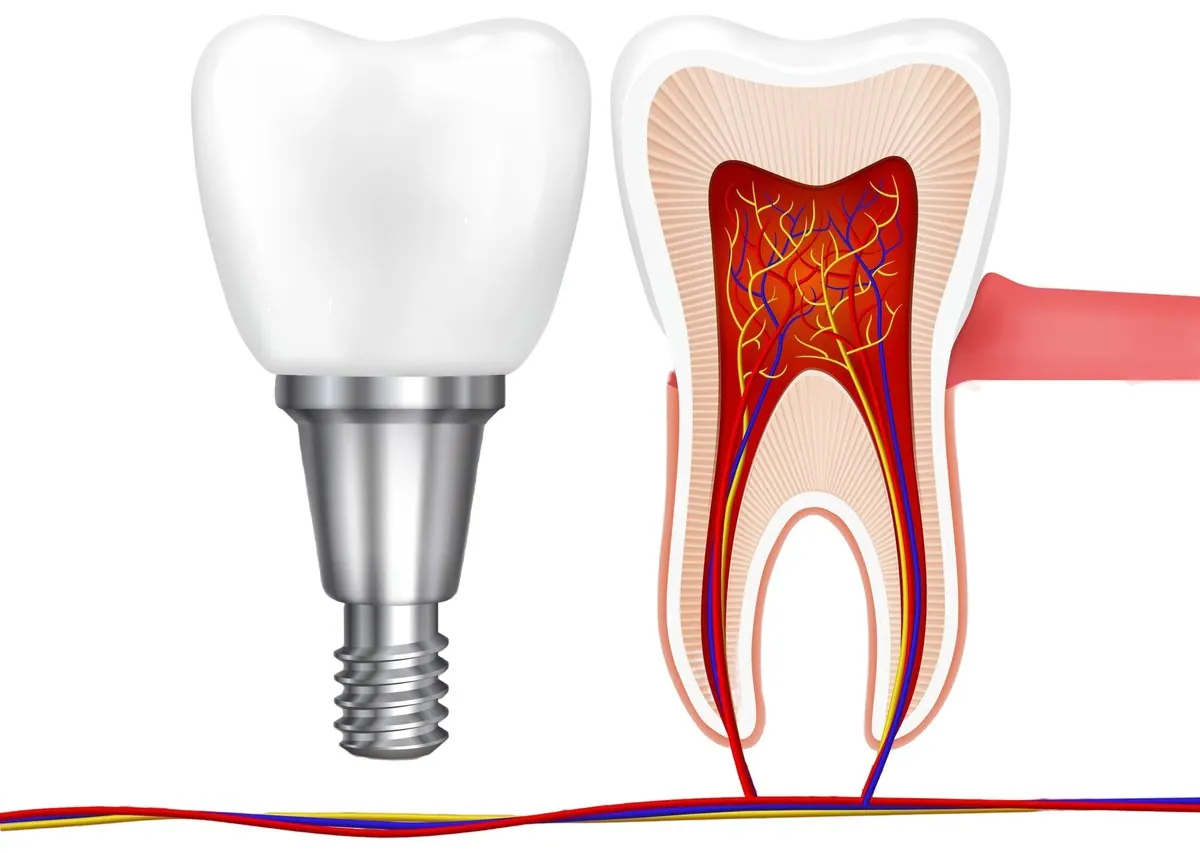
Inside every tooth is a chamber of nerve and blood vessels called the pulp. When bacteria reach it through deep decay, a crack, a leaking old filling or a blow to the tooth, the pulp becomes inflamed and then infected, and there is nowhere for the pressure to go. The signs are usually some combination of:
- A toothache that throbs, keeps you awake, or comes on without a trigger.
- Sensitivity to hot that lingers for more than a few seconds after the heat is gone. Short, sharp cold sensitivity is usually something less serious.
- Pain when you bite or tap the tooth, which means the infection has reached the ligament around the root.
- Swelling of the gum or face, a pimple on the gum that drains, or a bad taste. These are signs of a dental abscess and should be seen promptly.
- A tooth that has darkened, often after an old injury, with no pain at all. A dead nerve does not always hurt, which is why these are found on X-rays.
A toothache that suddenly stops is not good news: it usually means the nerve has died, and the infection is now moving into the bone.
Root canal vs. extraction and implant
| Root canal + crown | Extraction + dental implant | |
|---|---|---|
| What you keep | Your own tooth and root, with its ligament and bone | A titanium post and a porcelain crown; the natural root is gone |
| Visits | 1 to 2 for the root canal, plus the crown (often same day) | Extraction, healing, implant placement, healing, crown: 4 to 9 months |
| Surgery | None | Extraction and implant placement, sometimes a bone graft |
| Long-term outcomes | High success when the tooth is properly crowned; most last decades | High success; implants can carry a bite for decades |
| When it is the better choice | The tooth has enough sound structure to hold a crown and the root is not cracked | The tooth is split, decayed below the bone, or has failed a previous root canal |
| Cost | Lower, and usually covered in part as a basic or major service | Higher; implants are covered less often |
The Procedure
What a root canal in Pompano Beach is like at our office
From your side of the chair, a root canal feels like a long filling. The tooth is numb throughout, and most of the appointment is Dr. Berger working inside the tooth while you listen to music.
- Diagnosis. An exam, a cold and bite test to confirm which tooth is responsible, and an X-ray. A 3D CBCT scan is used when the root anatomy or the extent of infection is unclear.
- Numbing, and sedation if you want it. An infected tooth can be harder to numb, so the anesthetic is given time to work and topped up as needed. Nitrous oxide, oral sedation and IV sedation are all available; IV sedation is given by Dr. Berger, who holds a Florida conscious sedation permit.
- Isolation. A thin rubber sheet is placed around the tooth so the inside stays dry and free of saliva while it is cleaned.
- Cleaning and shaping. A small opening is made in the top of the tooth, the inflamed or dead pulp is removed, and each canal is cleaned, shaped and disinfected down to the tip of the root.
- Sealing. The canals are filled with a rubber-like material and sealed. If the infection was severe, medication may be left inside and the sealing done at a second visit a week or two later.
- The crown. A back tooth that has had a root canal is brittle and needs a crown to keep it from fracturing. At South Florida Smile Spa the crown can often be designed and milled the same day with our CEREC system, so you leave with the tooth finished.
Does a root canal hurt?
Not the procedure. The pain people associate with root canals is the toothache that brings them in, and the root canal is what relieves it. During treatment the tooth is fully anesthetized; if you feel anything, more anesthetic is given before anything continues. Afterward the tooth and the gum around it are tender for two to four days, especially on biting, and over-the-counter pain relief is usually all that is needed. Chew on the other side until the permanent crown is on. Call us if pain increases after the third day, if swelling develops, or if the temporary filling comes out.
Which root canals Dr. Berger does here, and which are referred
Dr. Berger performs routine root canals at South Florida Smile Spa: front teeth, premolars and molars with canals that are visible and accessible on the X-ray or scan. Cases that are better handled by an endodontist, a dentist who does nothing but root canals, are referred: teeth with very curved or calcified canals that are hard to find, teeth that have already had a root canal and need it redone, and cases where surgery at the root tip is needed. If a referral is the right call, you are told at the diagnosis visit, not partway through, and the crown is still done here afterward.
Why saving the tooth is worth it
A tooth with a root canal keeps its root in the bone, which keeps the bone from shrinking and the neighboring teeth from drifting. Nothing we can make, including an implant, matches a natural root’s feel and feedback when you chew. A properly cleaned, sealed and crowned tooth has a high long-term success rate and commonly lasts for decades; the American Dental Association’s patient guide to root canals puts it plainly: with proper care, the restored tooth can last a lifetime. The reasons a root canal fails are usually a missed canal, a crack, or a tooth that was never crowned and broke, and each of those is a reason to do the first one carefully and finish it with a crown.
Cost and insurance
The fee depends on the tooth, because front teeth have one canal and molars have three or four, on whether a CBCT scan or a second visit is needed, and on the crown that follows. You receive the exact figure after the diagnosis visit. Most dental insurance plans cover root canal treatment as a basic or major service and the crown as a major service, each up to the plan’s annual maximum; our team verifies your benefits and submits the claims, and monthly financing is available. If you are weighing cost against extraction, remember to compare it with the full cost of replacing the tooth, not with the extraction alone.

Care in Pompano Beach
Why patients choose South Florida Smile Spa for root canal treatment
- Root canal and crown in one place, often in one day. Dr. Berger does the root canal and makes the crown, and with CEREC the crown can be milled while you wait.
- Sedation in-house. Nitrous oxide, oral sedation and IV sedation for patients who would otherwise put the tooth off until it has to be extracted.
- Honest triage. If the tooth is better off with an endodontist, or is not worth saving, you hear that at the first visit.
- Toothaches seen quickly. A tooth that hurts is treated as an emergency; we see you as soon as possible to relieve the pain and get the diagnosis.
- Judgment-free. Many root canals are the result of years of avoidance. We treat the tooth, not the history.
Patients come to us for root canal treatment from Pompano Beach, Lighthouse Point, Deerfield Beach, Fort Lauderdale and Coconut Creek. If you are not sure whether your tooth needs a filling, an onlay or a crown after treatment, Dr. Berger explains the difference in crown, filling or onlay.
If a tooth is keeping you up at night
Call and tell us what is going on. We will see you as soon as we can, find out which tooth it is and whether it can be saved, and if a root canal is the answer, make it the appointment that ends the pain rather than one you dread.
South Florida Smile Spa · Dr. Nicole M. Berger, DDS · 572 E McNab Rd, Suite 102, Pompano Beach, FL 33060 · (954) 785-1100
Frequently Asked Questions
How long does a root canal take?
Usually 60 to 90 minutes for a single visit. Front teeth with one canal are quicker; molars with three or four canals take longer. Severe infections are sometimes treated over two visits a week or two apart so medication can work inside the tooth first. The crown is a separate step, often completed the same day with CEREC.
Does a root canal hurt?
No. The tooth is fully numbed, and the procedure itself feels like a long filling; if you feel anything, more anesthetic is given. Afterward the tooth is tender for two to four days, especially on biting, and over-the-counter pain relief is usually enough. The pain associated with root canals is the toothache beforehand, which the treatment removes.
Can I be sedated for a root canal?
Yes. Nitrous oxide, oral sedation and IV sedation are all available at South Florida Smile Spa. IV sedation is given and monitored by Dr. Berger, who holds a Florida conscious sedation permit, and is a common choice for patients who have put the tooth off because of anxiety. With oral or IV sedation you need a driver.
Do I really need a crown after a root canal?
For back teeth, yes. A tooth that has had a root canal is drier and more brittle, and the opening made to treat it weakens it further; without a crown, molars and premolars commonly fracture, and a fractured root canal tooth usually has to be extracted. Front teeth with minimal damage can sometimes be restored with a filling instead. The crown can often be made the same day.
Is it better to have a root canal or pull the tooth?
If the tooth has enough sound structure to hold a crown and the root is not cracked, saving it is almost always the better choice: it keeps your own root in the bone, involves no surgery, costs less and is done in one or two visits. Extraction and an implant is the right answer when the tooth is split, decayed below the bone, or has already failed a root canal. Dr. Berger’s root canal vs. implant comparison goes through the decision in detail.
How long does a root canal tooth last?
A properly treated and crowned tooth commonly lasts for decades and can last a lifetime with normal care. The usual reasons for failure are a missed canal, a crack in the root, or a tooth that was never crowned and broke. Regular exams catch problems early, and a failed root canal can often be retreated by an endodontist.
What happens if I wait?
The infection does not resolve on its own. It spreads from the nerve into the bone around the root, forms an abscess, and can destroy enough tooth or bone that the tooth can no longer be saved. Antibiotics calm the swelling temporarily but do not treat the source. A tooth that would have been a routine root canal often becomes an extraction after a few months of waiting.
Can a root canal be done the same day I call?
Often, yes. A toothache is treated as an emergency: call (954) 785-1100 and we will see you as soon as possible, usually the same day, to confirm the diagnosis and relieve the pain. Depending on the schedule and the infection, the root canal is either started at that visit or booked within days, with the tooth opened and medicated in the meantime if needed.
Do you see patients from outside Pompano Beach?
Yes. Patients come for root canal treatment from Lighthouse Point, Deerfield Beach, Fort Lauderdale, Coconut Creek and across Broward County. The office is at 572 E McNab Rd, Suite 102, Pompano Beach. Call (954) 785-1100 or request an appointment.