


Sleep, Grinding, and Your Smile: How Bruxism Quietly Wrecks Your Teeth
By Dr. Nicole M. Berger, DDS — South Florida Smile Spa, Pompano Beach
Quick answer
Most people who grind their teeth at night never hear it. The tells are in the morning — a dull headache at the temples, a jaw that is tight when you wake and loosens by noon, and cold-sensitive teeth with no cavity — and in the mouth, where a dentist sees flat, polished wear on the canines, hairline cracks, and chipped edges on front teeth. Untreated, bruxism shortens teeth, fractures fillings and crowns, and can drive jaw pain. It is also frequently linked to disrupted sleep, so a grinding workup in Pompano Beach includes questions about how you breathe at night.
I can usually tell a patient grinds before they sit all the way back in the chair. The wear facets on the canines give it away — flat, polished, and matched between the upper and lower arches in a way that normal chewing never produces. What surprises me, twenty years in, is how rarely the patient has any idea.
That is the defining feature of sleep bruxism: it is almost entirely nocturnal and almost entirely silent from the patient’s side. People come in for a chipped front tooth, a molar that suddenly hates cold, or a crown that cracked eighteen months after it was placed, and they describe each one as bad luck. It is not luck. It is a force problem, and it is happening while they sleep.
This post covers what grinding actually does to teeth, the morning signs most people miss, what bruxism can say about your sleep and your overall health, and what protects your smile — in that order, because the order matters.
What grinding does to a tooth, in slow motion
Bruxism is the clinical term for grinding or clenching the teeth outside of eating. The awake version is usually clenching and is often stress-linked. The sleep version is different: rhythmic jaw-muscle activity during sleep, frequently tied to brief arousals, generating forces that can be several times what you use to chew. Enamel, the hardest substance in the body, is designed for chewing forces applied for a few minutes at a time. It is not designed for hours of high-load grinding, night after night.
What I see, in roughly the order it appears:
- Wear facets. Flat, shiny spots on the canines and biting edges, matched between arches. This is the earliest sign and the one patients never notice.
- Shortened, translucent front teeth. The edges thin and the teeth lose length. Smiles start showing less tooth, and the face closes slightly more than it should.
- Cold sensitivity with no cavity. Micro-fractures in enamel and exposed dentin let temperature reach the nerve.
- Cracked and chipped teeth. Craze lines first, then real fractures — often in a molar with a large old filling, because the filling and the tooth flex differently under load. Many of the cracked teeth I treat in an emergency slot are grinding injuries that took years to arrive.
- Failed dental work. Porcelain chips, crowns crack, fillings pop out. If a well-made restoration failed early, the first question I ask is whether the patient grinds.
- Gum recession and notching at the gumline, where flexing teeth lose enamel at their thinnest point.
- Jaw muscle enlargement. The masseters — the muscles at the angle of the jaw — bulk up with use, squaring the lower face.
None of this reverses. Enamel does not grow back. A tooth ground down by a millimeter stays a millimeter shorter until it is restored, and every restoration placed into an uncorrected grinding habit is a restoration I expect to see again.
The morning signs most people miss
Because the grinding itself is silent, the symptoms show up somewhere else and at a specific time of day. The timing is the tell:
- A dull headache at the temples on waking, easing through the morning. The temporalis muscle, which does much of the clenching, runs right there.
- Jaw tightness or fatigue that is worst first thing and improves by midday. Jaw fatigue that gets worse through the day usually points to daytime clenching instead.
- Teeth that feel sore or ‘tall’ in the morning, as if the bite is not quite lining up.
- A partner who mentions the sound. Sleep grinding can be loud enough to wake the person next to you, though many grinders make no noise at all.
- Indentations on the tongue edges or a ridge along the inside of the cheek, from clenching and pressing against the teeth.
- Earache-like pain with a normal ear. The jaw joint sits directly in front of the ear canal.
Two of these together are enough to mention at your next visit. If jaw pain, clicking or locking is the dominant complaint rather than the teeth, that is a TMJ question and I covered it separately — including where injectables do and do not fit.
Why grinding is a whole-body signal, not a dental quirk
One clarification first, because it changes the whole conversation. In 2025 an international consensus panel writing in the Journal of Oral Rehabilitation updated the definitions of bruxism: sleep bruxism is masticatory muscle activity during sleep, and it is not a movement disorder and not a sleep disorder. It is a behavior. It matters when it becomes a risk factor for something else — worn enamel, a fractured molar, jaw muscle pain, a failing restoration — and in some people it is simply neutral. So the question in my chair is never only “do you grind?” It is “is your grinding costing you anything yet?”
This is the section I most want patients to read, because a night guard is the right first step and the wrong last one. Sleep bruxism is rarely the disease. It is frequently a symptom of something else going on overnight.
The night guard protects the teeth. It doesn’t answer the question of why you’re grinding — and that question is usually about sleep.
Dr. Nicole M. Berger, DDS
Sleep-disordered breathing. The sleep connection is measurable. In a polysomnography study of 914 adults with obstructive sleep apnea, published in the American Academy of Sleep Medicine’s Journal of Clinical Sleep Medicine, 49.7% met the criteria for sleep bruxism — roughly half — and about 86% of grinding episodes happened in temporal relation to a brief arousal from sleep. Notably, the grinding did not track with apnea severity itself, which tells you arousal is the thread running between them. The current understanding is that grinding may be part of the body’s response to a narrowed airway — the jaw moves, muscle tone rises, and breathing resumes. This is an association, not proof that one causes the other, and a dentist does not diagnose sleep apnea. But it means that when I see heavy wear in a patient who also snores, wakes unrefreshed, or has been told they stop breathing at night, I ask about a sleep evaluation through their physician before I do anything else. Several of my worst grinders turned out to be undiagnosed apnea patients, and treating the breathing quieted the grinding in a way no guard could.
Acid reflux. Nighttime reflux and grinding travel together, and the effect is not subtle. A 2026 scoping review in Nature and Science of Sleep gathered the case-control evidence and found people with gastroesophageal reflux disease were roughly five to seven times more likely to have sleep bruxism (odds ratios of 5.30, 6.58 and 6.87 across three studies). It compounds the damage, too: acid softens the enamel surface, and grinding then removes that softened layer faster than saliva can rebuild it. Patients with both wear their teeth at a rate that alarms me.
Medications, alcohol, caffeine and nicotine. In a study of 807 adults reported in Clinical Neuropharmacology, bruxism was present in 24.3% of people taking antidepressants against 15.3% of controls, and the authors put the incidence of new, antidepressant-associated bruxism at 14%. Paroxetine, venlafaxine and duloxetine came up most often. Stimulants, evening alcohol, late caffeine and tobacco belong on the same list. I never tell a patient to stop a prescribed medication — but I do tell them to mention grinding to the prescriber, because there are often alternatives.
Stress and anxiety. The link everyone assumes is real, especially for daytime clenching. It is simply not the only link, and it is the one that gets blamed when the real driver is a breathing problem nobody has looked for.
The ADA’s patient resource at MouthHealthy.org makes the same point in plainer language: grinding is worth investigating, not just padding. And the downstream effects are not confined to the mouth. Poor sleep affects blood pressure, blood-sugar regulation, mood and immune function, and chronic inflammation from untreated gum disease travels the same systemic routes. A patient who arrives with worn canines is often a patient whose sleep deserves a closer look, and that is a conversation a dentist is well placed to start.
What I check when a patient grinds
- The wear pattern. Where the facets are and how they match tells me whether the grinding is lateral, protrusive or mostly clenching, which changes the guard design.
- The bite. Interferences — high spots that the jaw has to slide around — can drive grinding. Sometimes a minor adjustment is all that is needed.
- Existing restorations. Every crown, filling and veneer gets checked for cracks and margin wear. Large old fillings on molars are the fractures waiting to happen.
- Muscles and joint. Palpation of the masseters and temporalis, range of motion, joint sounds.
- Sleep screening. Snoring, witnessed pauses, morning headaches, daytime sleepiness, neck size. A positive screen goes to the patient’s physician for a proper evaluation.
- Reflux, medications, habits. Asked plainly, because they change the plan.
What actually protects your teeth
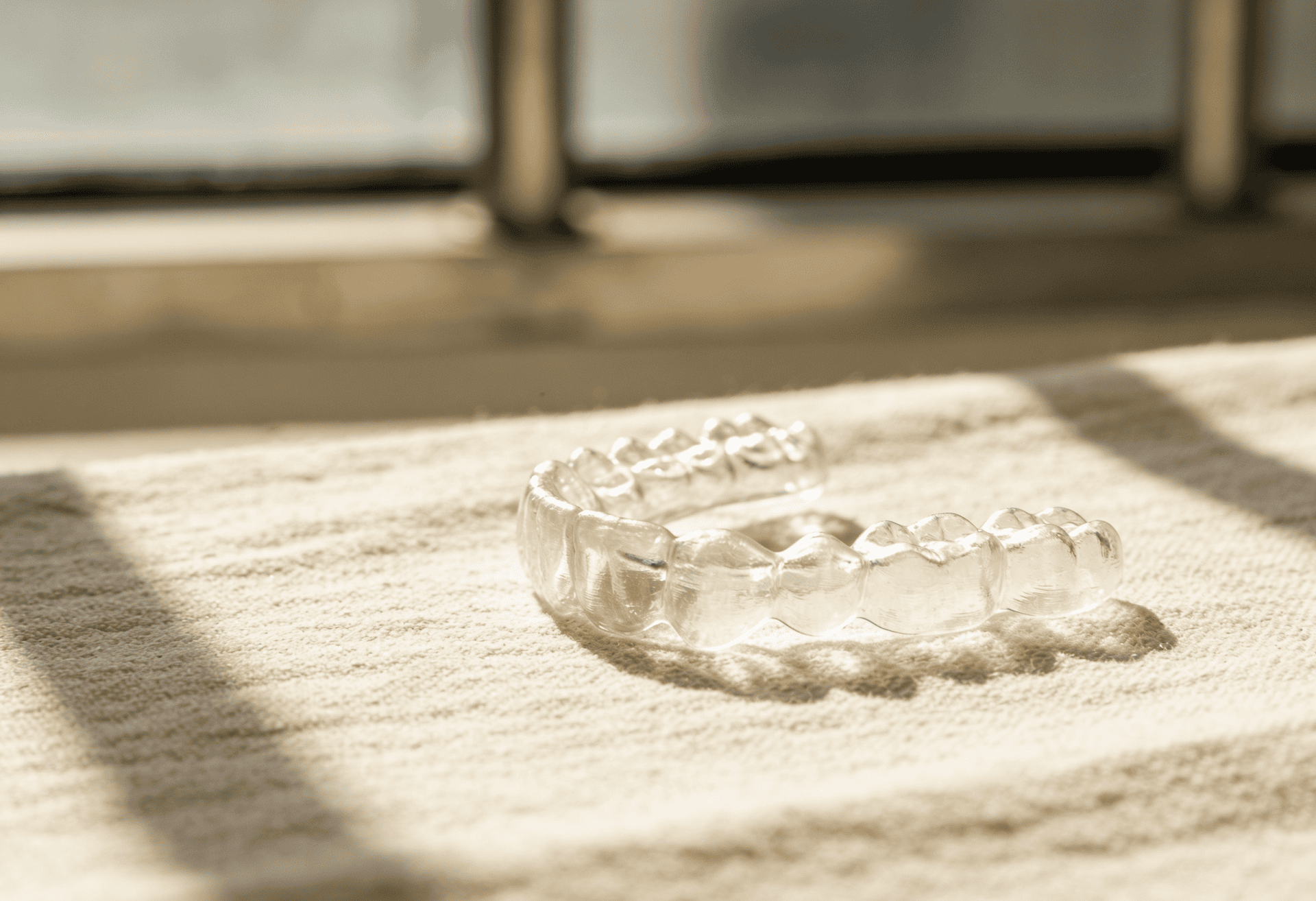
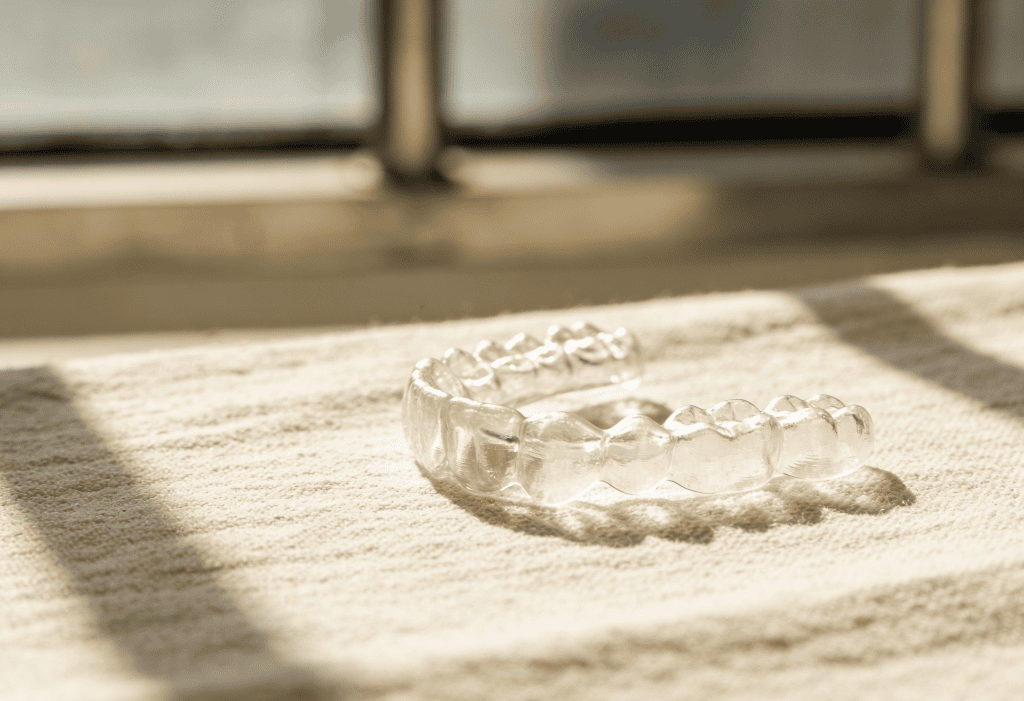
A custom night guard — not a pharmacy one. A properly fitted guard is made from digital scans of your own teeth, in a material and thickness chosen for your wear pattern, and adjusted so the bite on the guard is even. It absorbs and distributes force so enamel is not grinding on enamel. What it is not is a cure — you will still grind on the guard, and it will show wear, which is exactly the point. The drugstore version is a different product entirely, and the difference is not comfort. It is what the appliance does to your muscles.
| What matters | Custom night guard | Pharmacy boil-and-bite guard |
|---|---|---|
| How it is made | Digital scans of your own teeth; thickness and material chosen for your wear pattern | One generic blank, softened in hot water and bitten into at home |
| Material | Hard or dual-laminate acrylic, selected to stand up to your bite force | Soft thermoplastic |
| Bite adjustment | Adjusted chairside until contact on the guard is even across the arch | None — nothing is equilibrated |
| Effect on muscle activity | In a JADA study of 10 bruxers, a hard splint reduced nighttime masseter activity in 8 of 10 | In the same study, a soft splint increased muscle activity in 5 of 10 |
| Coverage and fit over time | Full arch, so force is spread across every tooth; checked and refit at recall visits | Often bulky or partial, loading some teeth more than others; distorts with wear, and a loose guard can move teeth |
| What it tells your dentist | The wear pattern on the guard maps where and how hard you grind, visit to visit | No usable record |
| What it does not do | Stop the grinding. It protects teeth; it does not treat the driver | Stop the grinding — and it may not reliably protect the teeth either |
I have replaced more than one crown that fractured with a drugstore guard in place.
Address the driver. If the sleep screen is positive, the evaluation comes first, and an apnea patient may end up with a different appliance entirely — one that holds the airway open rather than one that shields the teeth. Under the joint clinical practice guideline from the American Academy of Sleep Medicine and the American Academy of Dental Sleep Medicine, that appliance is prescribed by a sleep physician and fitted by a qualified dentist as a custom, titratable device — not ordered online. I make it in coordination with your physician, never instead of one. If reflux is present, managing it protects enamel directly. If a medication is implicated, the prescriber may have options.
Repair what is already damaged. Chipped edges can often be bonded. Fractured molars need onlays or crowns, and in a grinder I choose materials for strength, not just appearance. When wear has shortened many teeth and changed the bite, the answer is a planned rebuild rather than a series of repairs — that is a full-mouth rehabilitation conversation, and for the longer restorative appointments many patients choose IV sedation, which I administer and monitor personally.
Habit work for daytime clenching. Lips together, teeth apart, tongue on the palate — the resting position most clenchers have lost. Awareness cues through the day, and watching the caffeine cutoff, make a real difference to the awake version.
A composite patient: what a grinding workup looks like
The following is a composite scenario built from typical cases. It does not describe any single real patient.
A woman in her late 40s, an accountant in Deerfield Beach, comes in during tax season because a lower molar cracked on a piece of bread. She mentions, when asked, that she wakes most days with a headache she attributes to screen time, and that her husband has moved to the guest room because of her snoring. Her canines are flat. Two other molars have large old fillings with craze lines running from the margins.
The cracked molar gets a same-day crown. The two at-risk molars get onlays before they fracture. I make her a custom guard from a digital scan and, more importantly, send a note to her physician about the snoring, morning headaches and grinding together. Her sleep study comes back positive for moderate apnea. Six months later she is on treatment for it, the headaches are mostly gone, and the guard shows far less wear than I expected — because the reason she was grinding is being treated. The crown was the emergency. The sleep study was the outcome.
Frequently asked questions
How do I know if I grind my teeth at night?
Most sleep grinders do not hear themselves. The reliable signs are a dull headache at the temples on waking, jaw tightness that is worst in the morning and eases through the day, cold sensitivity without a cavity, and a partner who has heard the sound. A dentist confirms it by the wear pattern — flat, polished facets on the canines that match between the upper and lower teeth.
What damage does teeth grinding cause?
Grinding wears enamel flat, shortens and thins front teeth, causes cold sensitivity, creates craze lines and cracks — especially in molars with large fillings — and fractures crowns, veneers and fillings early. Over years it can change the bite and the shape of the lower face. Enamel does not regenerate, so the damage is cumulative.
Is teeth grinding related to sleep apnea?
Research has found that sleep bruxism is associated with brief sleep arousals and occurs more often in people with snoring and obstructive sleep apnea. This is an association, not proven cause and effect, and only a physician can diagnose sleep apnea. Dr. Berger screens grinding patients for sleep-breathing symptoms and refers to their physician when the screen is positive.
Do night guards stop teeth grinding?
No — a night guard protects the teeth while grinding continues. A custom guard made from digital scans absorbs and distributes force so enamel is not wearing against enamel, and it is adjusted so the bite on the guard is even. Stopping the grinding itself means addressing the driver, which may be sleep-disordered breathing, reflux, medication or stress.
Are pharmacy boil-and-bite night guards okay?
They are a different product from a custom guard. Over-the-counter guards are bulky and soft, are not adjusted to your bite, and can increase clenching or shift teeth if they fit poorly. For confirmed bruxism, a custom guard made to your scans and wear pattern is what protects restorations and enamel.
Can teeth grinding be caused by medication?
Certain medications are associated with increased bruxism, including some antidepressants (particularly SSRIs) and stimulants. Alcohol in the evening, late caffeine and nicotine are also associated with it. Never stop a prescribed medication on your own; mention grinding to the prescriber, who may have alternatives.
Can worn or cracked teeth from grinding be fixed?
Yes. Chipped edges can often be bonded; fractured molars need onlays or crowns chosen for strength; and when many teeth are worn and the bite has changed, a planned full-mouth rehabilitation restores them together. Any repair should be paired with a custom guard and, where indicated, treatment of the underlying cause, or the new restorations will meet the same forces that damaged the originals.
Finding out whether you grind
If two or three of the morning signs above sound familiar, or if a tooth has cracked without an obvious reason, it is worth a look. The exam is short, the wear pattern is unambiguous, and the conversation about sleep is one I would rather have early than after the third crown.
I see patients from Pompano Beach, Fort Lauderdale, Deerfield Beach, Lighthouse Point and Boca Raton. Call (954) 785-1100 or request an appointment through our website. South Florida Smile Spa is at 572 E McNab Rd, Suite 102, Pompano Beach, FL 33060.
If your mornings start with a headache
A grinding exam is short. We read the wear pattern, check your existing crowns and fillings for cracks, and ask the sleep questions that tell us whether a guard is the whole answer or only the first step.
South Florida Smile Spa · Dr. Nicole M. Berger, DDS · 572 E McNab Rd, Suite 102, Pompano Beach, FL 33060 · (954) 785-1100
Dr. Nicole M. Berger, DDS practices cosmetic, restorative and implant dentistry in Pompano Beach, Florida. More about Dr. Berger.
This article is for general education and is not a substitute for an in-person examination and diagnosis. Sleep apnea is diagnosed by a physician; a dentist can screen and refer.

Dr. Nicole M. Berger, DDS
Dr. Berger has cared for patients in Pompano Beach for over two decades at South Florida Smile Spa, with a focus on cosmetic dentistry, implants and reconstruction, and sedation options for anxious patients.