

Root Canal, Then a Crown: Why I Don’t Consider the Tooth Finished Until Both Are Done
Quick answer — do you need a crown after a root canal?
On a back tooth, almost always. A root canal removes the infected nerve and saves the tooth, but it also hollows out a tooth that was already broken down by decay or a crack. What is left is a shell that can split under normal chewing force, and a split root usually cannot be repaired. The American Association of Endodontists is direct about it: “Posterior teeth with root canal treatment should receive cuspal coverage restorations.” In an eight-year study, teeth that received a full-coverage crown survived at 84 percent, teeth given only a filling survived at 71 percent, and teeth left with no permanent restoration survived at 58 percent. Front teeth are the exception and can often be restored with bonding alone. Dr. Nicole M. Berger, DDS plans and places both the root canal and the crown at South Florida Smile Spa in Pompano Beach.
By Dr. Nicole M. Berger, DDS — South Florida Smile Spa, Pompano Beach
There is a particular appointment I wish I never had to have. A patient comes in with a tooth broken at the gumline. They are not in much pain, which is the strange part. We take an X-ray, and there is a root canal in that tooth, done well, two or three years ago. And there is no crown on it.
Almost every time, the story is the same. The root canal fixed the pain, the tooth felt normal again, the crown appointment got moved once and then forgotten — and nobody explained that the root canal was half of a two-part repair, the half that does not hold the tooth together.
So this is the explanation I want every patient to have before they leave with a temporary filling. Why a crown after root canal treatment is not an add-on, why the timing matters more than people realize, when a crown genuinely is not necessary, and what to do if you are reading this with a root canal you had a while ago and a crown you never got around to.
What a root canal does, and what it leaves behind
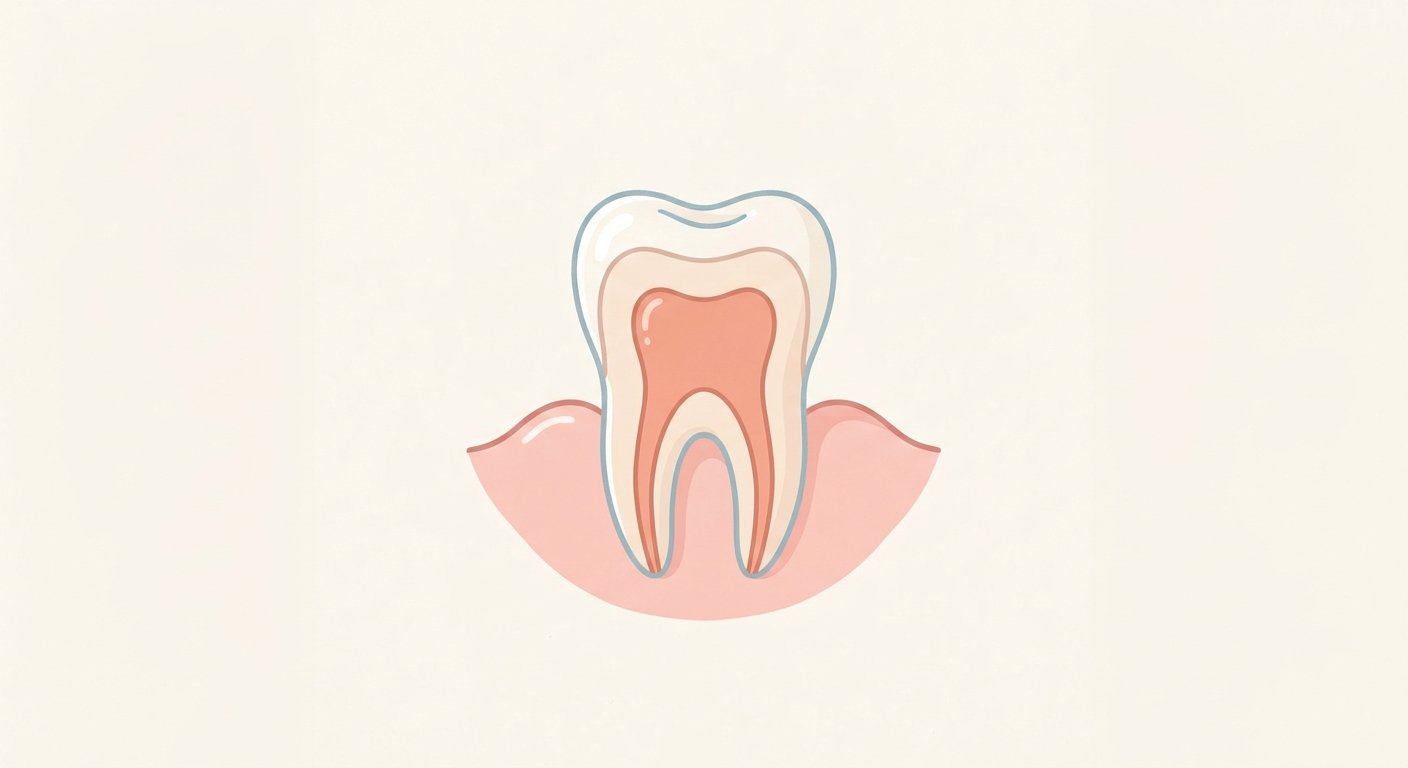
A tooth is not a solid block of enamel. It has a hollow chamber down the middle, and inside it sits the pulp: nerve, blood vessels, connective tissue. When decay or a crack reaches the pulp, bacteria get into a space the immune system cannot clean and the tissue dies. That is the throbbing, keeps-you-up-at-night pain people associate with needing root canal treatment, and left alone it becomes a dental abscess.
Root canal treatment solves that completely. I open the top of the tooth, clean the dead tissue out of the canals, shape and disinfect them, and seal them so bacteria cannot recolonize the space. The infection is gone. As the American Dental Association’s MouthHealthy guidance puts it, “Root canals are used to repair and save your tooth instead of removing it.”
Here is what the same procedure does to the tooth’s structure. To reach the canals I have to remove the roof of the pulp chamber — and in a molar, that roof is the piece of dentin that ties the cusps to one another. Take it away and the cusps become separate walls with nothing bracing them across the middle. Add the decay or fracture that killed the nerve in the first place, plus whatever old filling was already there, and you are left with a thin-walled shell around a hollow center.
Now consider what that shell has to do. A molar handles well over a hundred pounds of force per bite, thousands of times a day, at an angle. Unsupported walls fail under that load — not immediately and not dramatically, which is the problem. They flex, they craze, and one day one splits off. If the split runs below the gumline into the root, there is nothing left to crown; that tooth comes out. A crown prevents this by doing what a filling cannot: it wraps the whole tooth and ties the cusps together from the outside, so force is distributed around a ring instead of wedging the walls apart. Dentists call it cuspal coverage, and it is the entire point.
What the research shows about crowning a root-canal-treated tooth
I am wary of dentists who make clinical claims with nothing behind them, so here is the evidence I rely on — it is unusually consistent. The study most often cited comes from the Journal of Prosthetic Dentistry in 2002, which followed root-canal-treated teeth while controlling for tooth type and decay at the access opening. Its finding: “endodontically treated teeth not crowned after obturation were lost at a 6.0 times greater rate than teeth crowned after obturation,” with a confidence interval of 3.2 to 11.3. Six times.
A 2016 eight-year retrospective study in the Journal of Endodontics broke it down by what the tooth actually received: eight-year survival was 84 percent with a full-coverage crown, 71 percent with a buildup and nothing more, and 58 percent with no permanent restoration at all. Buildup-only teeth were 2.29 times more likely to be extracted. Older work on molars without crown coverage found survival as low as 36 percent at five years.
A 2025 randomized trial in the Journal of Dentistry compared full crowns against direct composite restorations on root-canal-treated molars over three years: survival was 93.3 percent for crowns and 76.7 percent for direct restorations. The authors noted the difference did not reach statistical significance over that short a window, and concluded that “crowns were more predictable, especially for bruxers.” That clause matters in South Florida, where I diagnose clenching and grinding constantly — a patient who grinds loads that hollow tooth harder, in the direction its walls resist least.
The professional guidance follows the data. The American Association of Endodontists states that “Posterior teeth with root canal treatment should receive cuspal coverage restorations,” and notes that bonded restorations, “once thought to obviate the need for cuspal coverage,” have not held up over longer follow-up.
The four-month window nobody mentions
This is the part that surprises patients most, and it is the most useful thing in this post.
That 2016 study did not only look at whether a crown was placed. It looked at when. Teeth crowned within four months of the root canal had an eight-year survival rate of 85 percent. Teeth crowned later survived at 68 percent, and waiting past four months made a tooth roughly three times more likely to be extracted. The authors concluded that patients “may benefit by maintaining their natural dentition by timely placement of crown after RCT, which otherwise may have been extracted and replaced by implant because of any delay in crown placement.”
Two things happen during that delay. The first is mechanical: every week the tooth spends unprotected is a few thousand more chewing cycles flexing walls with nothing holding them together. The second is biological, and patients never anticipate it. A temporary filling is a temporary seal. The AAE is blunt about both limits — “Temporary restorations do not effectively prevent contamination for extended time periods,” and “the temporary restoration does not protect the tooth against fracture.” Bacteria leak back into canals I spent an hour disinfecting, and a root canal that succeeded at the time can need redoing.
Which is why the AAE’s position on timing is that “an immediate restoration should be placed, whenever possible,” and why waiting to see whether the root canal “works” before committing to the crown is a strategy that loses teeth. In my office we book the crown appointment before you leave the root canal appointment, and I would much rather you reschedule it twice than leave it open-ended.
“But my tooth feels fine”: comfort is not the same as strength
A root canal removes the nerve. The tooth cannot feel pressure, temperature or pain from inside any more. The signal you have relied on your whole life to tell you something is wrong with a tooth has been switched off — permanently, and by design. A root-canal-treated tooth developing a crack will not warn you. It will feel perfectly normal right up until the day a cusp comes off in a bite of bread.
I have had this conversation hundreds of times, and “it hasn’t bothered me at all” is not reassurance — it is the expected result of a successful root canal. It tells us the infection resolved and nothing about whether the walls of that tooth are intact. Compare it to a cracked tooth that still has its nerve. That tooth tells you about the crack: a sharp zing when you release biting pressure, cold sensitivity, an ache that moves around. Those symptoms are a gift, because they bring people in while the tooth can still be saved. After a root canal, you do not get them.
When a root canal does not need a crown
I want to be honest about the exceptions, because “every root canal needs a crown” is an overstatement. Front teeth are often fine without one. Incisors and canines take force along their length rather than across cusps — they have no cusps to split apart — and the access opening is a small hole in the back of the tooth rather than the removal of a structural roof. If a front tooth needed root canal treatment after a trauma rather than extensive decay, and is otherwise substantially intact, a well-bonded composite in the access opening is frequently all it needs. A premolar that arrived with thick walls and intact marginal ridges can sometimes take a bonded onlay rather than a full crown — but note that an onlay is still cuspal coverage. The question is how much of the tooth gets covered, not whether the cusps get protected.
What is not on that list is a molar or premolar with the kind of decay or fracture that drove the nerve to die in the first place. That tooth gets covered.
How I decide: how much tooth is actually left
Regular readers will recognize the framework, because it is the one I use for every restorative decision: how much tooth is left decides the answer. A root canal does not change the framework. It moves the tooth several steps along it. What I am measuring:
- How many walls are standing, and how thick they are. Four solid walls is a different tooth from two thin walls and a gap where the third used to be.
- Whether the marginal ridges survived. These are the raised rims where the tooth meets its neighbors; losing both takes a great deal of structural integrity with them.
- How far below the gumline the damage goes. I need a band of sound tooth above the gum for the crown to grip — the ferrule, below.
- Whether a crack is already there, and how far it runs. For this I use our in-house cone beam CT, which shows root anatomy and bone in three dimensions rather than the flat shadow of a conventional X-ray.
- What the bite is doing. A heavy bite, a grinding habit, or a tooth taking force at an awkward angle all raise the load on the restoration.
Sometimes that assessment leads somewhere other than a crown. If the fracture already runs into the root, or there is not enough tooth above the gum to hold anything, the honest answer is that the tooth cannot be rebuilt, and we talk about whether to save the tooth or replace it. I would far rather have that conversation before the root canal than after, which is why the assessment comes first.
Posts, cores and the ferrule: the part under the crown
A post does not strengthen the tooth. This is the most persistent misunderstanding I meet. A post — a small fiber or metal rod cemented into a canal — exists only to anchor the core material when too little tooth remains above the gumline to hold a filling on its own. MouthHealthy puts the purpose accurately: a post “helps support a crown if you need one.” It does not reinforce the root. The AAE warns that “the use of a post carries with it a certain attendant risk of root fracture,” and that any early strengthening from a fiber post “is probably lost with time and function.” So I place one when the tooth needs it for retention, and not otherwise.
The core rebuilds the shape. Once the canals are sealed I fill the access opening and the missing walls with bonded composite. On its own that is not enough — which is what the 71 percent figure for buildup-only teeth is telling us — but under a crown it is the foundation the crown sits on.
The ferrule is what I am really protecting. A ferrule is a continuous collar of sound tooth structure, ideally one and a half to two millimeters tall, that the crown grips all the way around above the gumline. A crown with a good ferrule grips tooth. A crown without one grips buildup material, and buildup material does not hold under years of lateral force. When damage extends too far down, there are ways to create a ferrule — orthodontic extrusion to bring the tooth up, or crown lengthening surgery to move the gum and bone down — and I plan those with our periodontist. If neither is realistic, that is one of the honest reasons to stop trying to save a tooth.
What the appointments actually look like
Visit one — the root canal. Local anesthetic, a rubber barrier isolating the tooth, access through the top, cleaning and shaping the canals, disinfecting, sealing them, then a core buildup and a temporary covering. Routine cases I do here; complex anatomy, retreatment of a previous root canal, or a tooth needing surgical endodontics I refer to a specialist, because a patient is better served by the right hands than by my pride.
Visit two — the crown. I shape the tooth, scan it with our intraoral scanner, and then one of two things happens. For many teeth I can mill a ceramic crown here and fit it the same day with our same-day restoration system. For heavier bites, more demanding aesthetics or more complex margins, a laboratory crown is the better restoration and the tooth wears a well-made temporary for a couple of weeks. I have written in detail about how I decide between a same-day and a lab-made crown; the short version is that it depends on the tooth, not on convenience.
Sometimes these collapse into one visit, which is the ideal: root canal, buildup and final crown in a single sitting, with no vulnerable interval at all. For patients who find all of this genuinely difficult — and many do, particularly anyone whose fear of dentistry began with a root canal decades ago — the whole sequence can be done under oral or IV sedation, planned around a full review of your medications.
The temporary is not a crown
A temporary filling or temporary crown has two jobs: keep the hole sealed and keep the space open until the real restoration arrives. It is designed to come off easily, because I have to remove it — not to bear load for months. So while you are in the temporary phase, stay off that tooth for anything hard, chewy or sticky — ice, nuts, hard candy, caramel, bagels — and chew on the other side. Keep brushing and flossing it, but pull the floss out sideways rather than snapping it up past the temporary. And if the temporary comes off or breaks, call us the same day. That is not a minor inconvenience to ride out until your next appointment; it is a tooth sitting unprotected, and we will get you in.
A representative case: the molar that waited eleven months
The following is a composite scenario, a blend of details from many patients. It is not a real individual and not a testimonial.
A man in his late forties came in with a lower right molar that had broken while he was eating. He was not in pain. He mentioned, almost in passing, that he had had a root canal on that tooth “last year sometime” at another office, and had been meaning to get the crown.
The root canal had been done well — canals cleanly sealed, healthy bone around the roots. What had failed was everything above it. The temporary filling had worn into a dished-out crater, the distal wall had sheared off at some point he never noticed, and the lingual wall had a crack running from the top of the tooth down past the gumline. On the cone beam scan I could follow that crack into the root.
There was no ferrule left on that side and no realistic way to create one without taking the fracture line with it. A tooth with a technically perfect root canal had to be extracted, eleven months after someone had successfully saved it. We planned the site for an implant, which our periodontist placed surgically a few months later and which I restored once it had integrated.
What stays with me is how avoidable it was. Nothing went wrong with the difficult part. The tooth was lost in the gap between finishing the hard work and finishing the job — and he told me nobody had ever said the word “crown” to him with any urgency. I believe him, because I meet that gap constantly.
What keeping your own tooth is worth to the rest of your body
I write often about the mouth not being a sealed compartment, and this is one of the clearest examples of why that is not a slogan. Start with the obvious: a tooth that fractures beyond repair comes out, and losing molars changes how you eat. People with compromised chewing shift away from raw vegetables, fibrous fruit and lean meat toward food that needs less work, and that shift is measurable in diet quality. I have written before about what missing teeth do to nutrition — a quieter consequence than pain, and a longer-lasting one.
Then there is the inflammatory side. An untreated infected tooth is a chronic bacterial reservoir with direct access to the bloodstream, and the relationship between oral and systemic inflammation runs in both directions — the same two-way street I have described for gum disease and cardiovascular disease and for gum disease and rheumatoid arthritis. A root canal shuts that reservoir down. A crown is what keeps it shut, by keeping the tooth in one piece and the seal intact.
And there is a cascade patients rarely see coming. The teeth on either side drift, the tooth above or below drops into the space, the bite redistributes onto teeth that were not built for it, those teeth crack — and a problem that started as one unprotected molar becomes the kind of situation that needs full-mouth rehabilitation a decade later.
The ADA’s MouthHealthy guidance on root canals ends on a line I quote constantly: “With proper care, your restored tooth can last a lifetime.” Note where the weight falls in that sentence — on restored, and on proper care. A root canal with no crown over it is not a restored tooth. It is a tooth waiting.
If you have already waited
A fair number of people will read this with a root canal somewhere in their mouth and no crown on it. Do not panic, and do not assume it is too late. Those survival figures are population averages, not verdicts on your tooth, and plenty of teeth that waited longer than four months crown up beautifully and last decades. What has changed is that we cannot know without looking — so find out soon, rather than waiting for the tooth to tell you, because it cannot.
Come in for an evaluation. We will X-ray the tooth, check the canals and the bone, look hard for cracks, and measure what is left above the gumline. Most often the tooth is intact enough to crown and we get on with it. Sometimes there is a crack still above the gum, and we can crown it with a clear-eyed conversation about the odds. Occasionally the tooth is past saving — and knowing that now, while you can plan calmly, beats discovering it on a Saturday night. In the meantime: chew on the other side, avoid anything hard or sticky on that tooth, and if the temporary is gone or the tooth has a visible crack or sharp edge, treat it as urgent rather than routine.
Frequently asked questions: crowns after root canal treatment
Do you always need a crown after a root canal?
On molars and most premolars, yes, and the professional guidance is explicit that posterior teeth with root canal treatment should receive cuspal coverage restorations. Reaching the canals requires removing the structural roof of the tooth, which leaves unsupported walls that split under chewing force. Front teeth are a genuine exception: incisors and canines have no cusps to separate and can often be restored with a bonded composite in the access opening alone, especially when the root canal followed a trauma rather than extensive decay.
How long can you wait to get a crown after a root canal?
The evidence points to four months as the threshold worth respecting. In an eight-year study, teeth crowned within four months of root canal treatment survived at 85 percent, while teeth crowned after four months survived at 68 percent and were about three times more likely to be extracted. Sooner is better still, because a temporary filling neither seals the canals against bacteria for long nor protects the tooth against fracture. Where the tooth allows it, finishing the root canal and the crown in a single visit removes the vulnerable interval entirely.
What happens if you never get the crown after a root canal?
Two things tend to go wrong. The tooth fractures, often at or below the gumline, and a fracture that reaches the root usually cannot be repaired, so the tooth has to be extracted. Separately, bacteria leak past the temporary filling and reinfect canals that were successfully cleaned, meaning the root canal itself may need redoing. Research following root-canal-treated teeth found that teeth left uncrowned were lost at six times the rate of crowned teeth, and teeth with no permanent restoration at all had an eight-year survival of 58 percent.
Can a root canal tooth have a filling instead of a crown?
On a back tooth a filling alone is a measurably weaker option. Teeth restored with only a composite or amalgam buildup after root canal treatment had an eight-year survival of 71 percent compared with 84 percent for teeth that received a full-coverage crown, and were 2.29 times more likely to be extracted. A bonded onlay that still covers the cusps can be appropriate for a premolar that came to treatment with thick walls and intact marginal ridges, but that is still cuspal coverage rather than a plain filling.
Does a root canal tooth always need a post under the crown?
No, and a post does not strengthen the root, which is the most common misunderstanding about them. A post exists to anchor the core buildup when too little tooth remains above the gumline to retain it on its own. Guidance from the American Association of Endodontists notes that using a post carries some risk of root fracture and that any early reinforcement from a fiber post is probably lost with time and function. When enough tooth structure remains, the buildup is bonded without a post.
Can a crowned root canal tooth still break or fail?
It can, which is why the figures are survival rates rather than guarantees. A crown ties the cusps together and distributes force around the tooth, but it cannot restore lost root structure. Failures usually trace back to too little sound tooth above the gumline for the crown to grip, a crack that was already present and extended, heavy clenching or grinding, or decay developing at the crown margin years later. Professional cleanings, a night guard where grinding is present, and attention to the gumline are what protect the restoration.
Does getting a crown after a root canal hurt?
The crown appointment is usually the easier of the two, partly because the tooth no longer has a nerve inside it. Local anesthetic is still used, since the gum and the surrounding tissue are sensitive even when the tooth is not. Afterward the gum may feel tender for a day or two. For patients who find dental treatment genuinely difficult, the root canal and the crown can both be completed under oral or IV sedation, planned in advance around a full review of current medications.
Had a root canal and no crown yet? Let’s finish the job.
If you have a root canal waiting on its crown — whether that was two months ago or two years ago — the useful next step is an evaluation while the tooth is still intact enough to protect. Tell our front desk you have an unrestored root canal and we will get you looked at promptly.
South Florida Smile Spa · 572 E McNab Rd, Suite 102, Pompano Beach, FL 33060 · (954) 785-1100
Dr. Nicole M. Berger, DDS practices at South Florida Smile Spa, 572 E McNab Rd, Suite 102, Pompano Beach, FL 33060, and welcomes patients from Pompano Beach, Fort Lauderdale, Deerfield Beach, Lighthouse Point and Coconut Creek.
This article is for general education and is not a substitute for individual examination, diagnosis, or treatment planning. Whether a particular tooth needs a crown, and whether it can still be restored, can only be determined after an in-person examination and radiographs.

Dr. Nicole M. Berger, DDS
Dr. Berger has cared for patients in Pompano Beach for over two decades at South Florida Smile Spa, with a focus on cosmetic dentistry, implants and reconstruction, and sedation options for anxious patients.